
Pigmentation • Melasma
Melasma: What It Is and How It Differs from ABNOM
A brown haze spreading across the cheekbones is called melasma in one place and ABNOM in another. The two sit at different depths in the skin. Energy chosen for dermal pigment, used as it is on a face that also carries melasma, can leave the pigment darker than before; energy kept low for melasma never reaches dermal pigment at all. This page explains why that one distinction changes the direction of treatment.
What is Melasma?
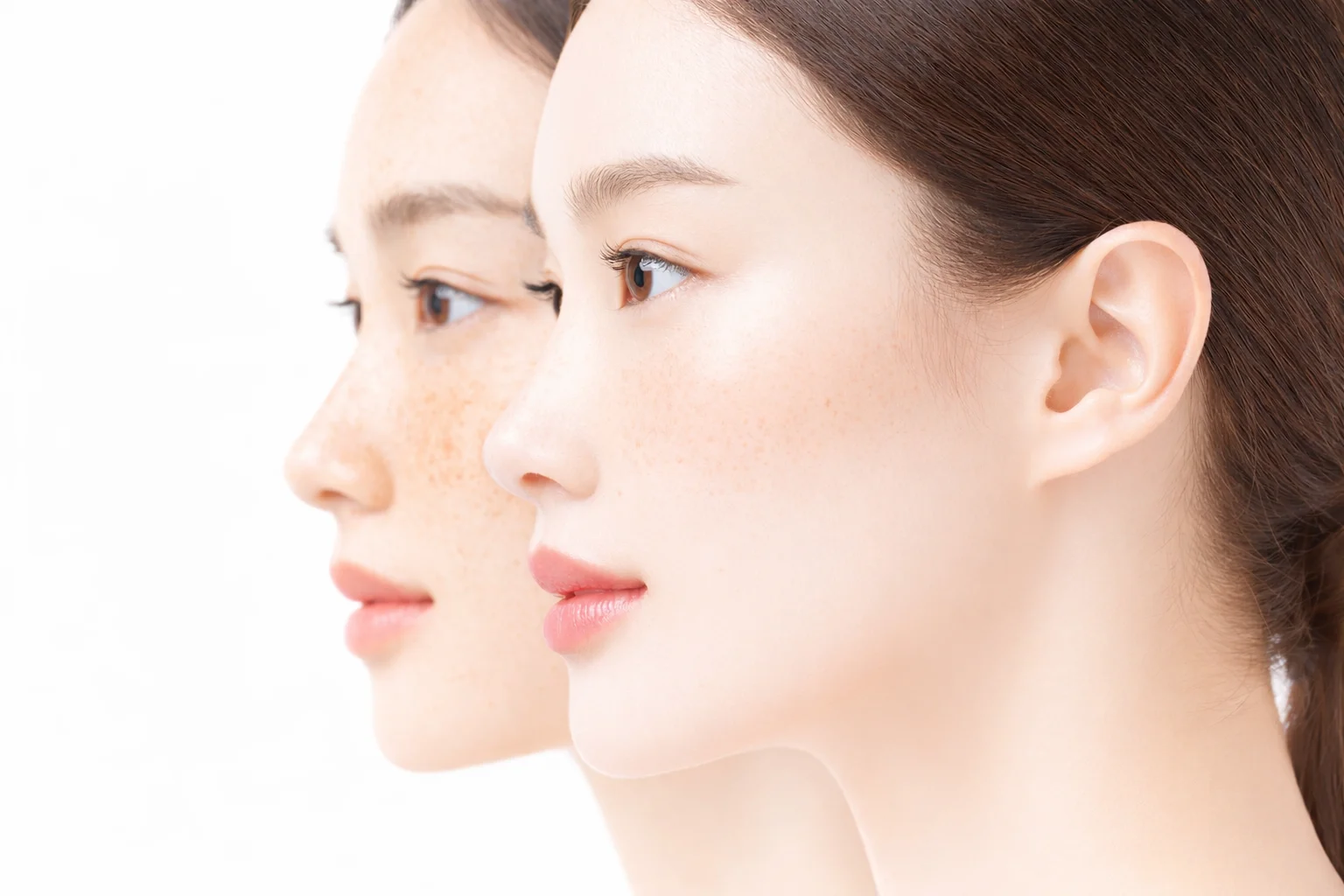
You look in the mirror and the skin above your cheekbones seems clouded, as though a shadow were sitting on it, and after one summer it has darkened a little further — that is where the conversation about melasma usually begins. Clinically, melasma is a brown to grey-brown macule and patch with irregular borders, appearing symmetrically on sun-exposed areas of the face.
The distribution follows a few set patterns. The centrofacial pattern, covering the forehead, cheeks, nose and upper lip while sparing the philtrum, accounts for 50~80% of cases and is the most common; the malar pattern, concentrated on the cheeks and nose, and the mandibular pattern along the jawline follow. Extrafacial cases on exposed areas such as the arms or shoulders are also reported.
It occurs mainly in women, and the literature generally describes onset in the 20s to 40s. It is more common in darker skin (Fitzpatrick types III~IV, or III~V depending on the source), and a family member with the same condition is reported in about 60% of cases.
There is no single cause. Light exposure is the factor most consistently identified in both onset and recurrence, and short-wavelength visible light (blue light) has more recently been implicated in driving pigment in darker skin. Hormonal change — pregnancy, oral contraceptives, intrauterine devices and hormone replacement therapy containing estrogen and progesterone — as well as thyroid disease and phototoxic drugs or cosmetics are also associated. In occupations with repeated exposure to strong heat, such as cooking, baking, metalwork and glasswork, heat itself is described as making melasma chronic. The same literature notes, however, that no study has yet systematically examined the effect of solar infrared radiation on melasma.
Recent work views melasma not simply as melanocytes working too hard, but as a chronic inflammatory change in the microenvironment between the epidermis and the dermis. When the basement membrane is damaged, melanocytes and melanin granules drop into the dermis, and this is offered as the reason melasma persists and returns. Melasma is therefore less a matter of erasing something than of managing it over a long period.
How is it different from ABNOM?
ABNOM (acquired bilateral nevus of Ota-like macules) rises symmetrically over the cheekbones, so at first glance it looks almost identical to melasma. Bilateral facial pigment that appears in adulthood is often diagnosed as melasma, and the literature describes ABNOM as commonly misdiagnosed that way.
The difference lies in the layer the pigment occupies. ABNOM pigment comes from spindle-shaped melanocytes scattered through the papillary to mid dermis. Pigment sitting in the dermis takes on a blue cast when viewed from above, so ABNOM appears blue-brown or grey-blue and scattered in discrete specks, while melasma is light brown and runs together as though bleeding outward. In a dermoscopic study comparing 50 patients with melasma and 46 with ABNOM, light brown was seen in 98% of melasma and 10.9% of ABNOM; blue-brown or grey appeared only in ABNOM, in 63%; and a dotted homogeneous pattern likewise appeared only in ABNOM, in 52.2%. In the same study, mean age was 43±8 years for melasma and 33±10 years for ABNOM.
That difference decides the treatment. Melasma is a lesion that pushes back when provoked, so it is approached carefully with low energy, with sun protection and maintenance carried on for a long time. Dermal ABNOM pigment, by contrast, is not reached by low energy that disperses in the upper epidermis. The two together on one face is the hardest situation — in a retrospective study of 110 patients with ABNOM treated with a 1064 nm Q-switched laser, post-inflammatory hyperpigmentation after treatment occurred in 10.0% overall, but in 33.3% of those who also had melasma, against 5.4% of those who did not. A diagnosis read the wrong way does not only cost time; it can leave the pigment darker.
ABNOM
- Layer the pigment sits in
- Spindle-shaped melanocytes scattered through the papillary to mid dermis
- Color and pattern (dermoscopic comparison study, n=96)
- Blue-brown or grey-blue, scattered in discrete specks (dotted homogeneous pattern 52.2%)
- Where it tends to appear (as described in the literature)
- Centered on both cheekbones, extending to the eyelids, temples, alae nasi and root of the nose
- Mean age (dermoscopic comparison study, n=96)
- 33±10 years
- Course
- Clearance rates reported to rise with the number of sessions (3~6 month intervals, one retrospective study)
Melasma
- Layer the pigment sits in
- Increased epidermal melanin, with basement membrane damage and dermal change on top of it
- Color and pattern (dermoscopic comparison study, n=96)
- Light brown running together as though bleeding outward (light brown 98%)
- Where it tends to appear (as described in the literature)
- Forehead, cheeks, nose and upper lip (sparing the philtrum), and the jawline. Involvement around the eyes is described as uncommon
- Mean age (dermoscopic comparison study, n=96)
- 43±8 years
- Course
- Even when it improves, recurrence is common if light and hormonal exposure continue
The Other’s Root-Blocking Melasma Solution
What treatment does is not to burn pigment away, but to reduce the conditions that make pigment while gradually drawing down the melanin already deposited.
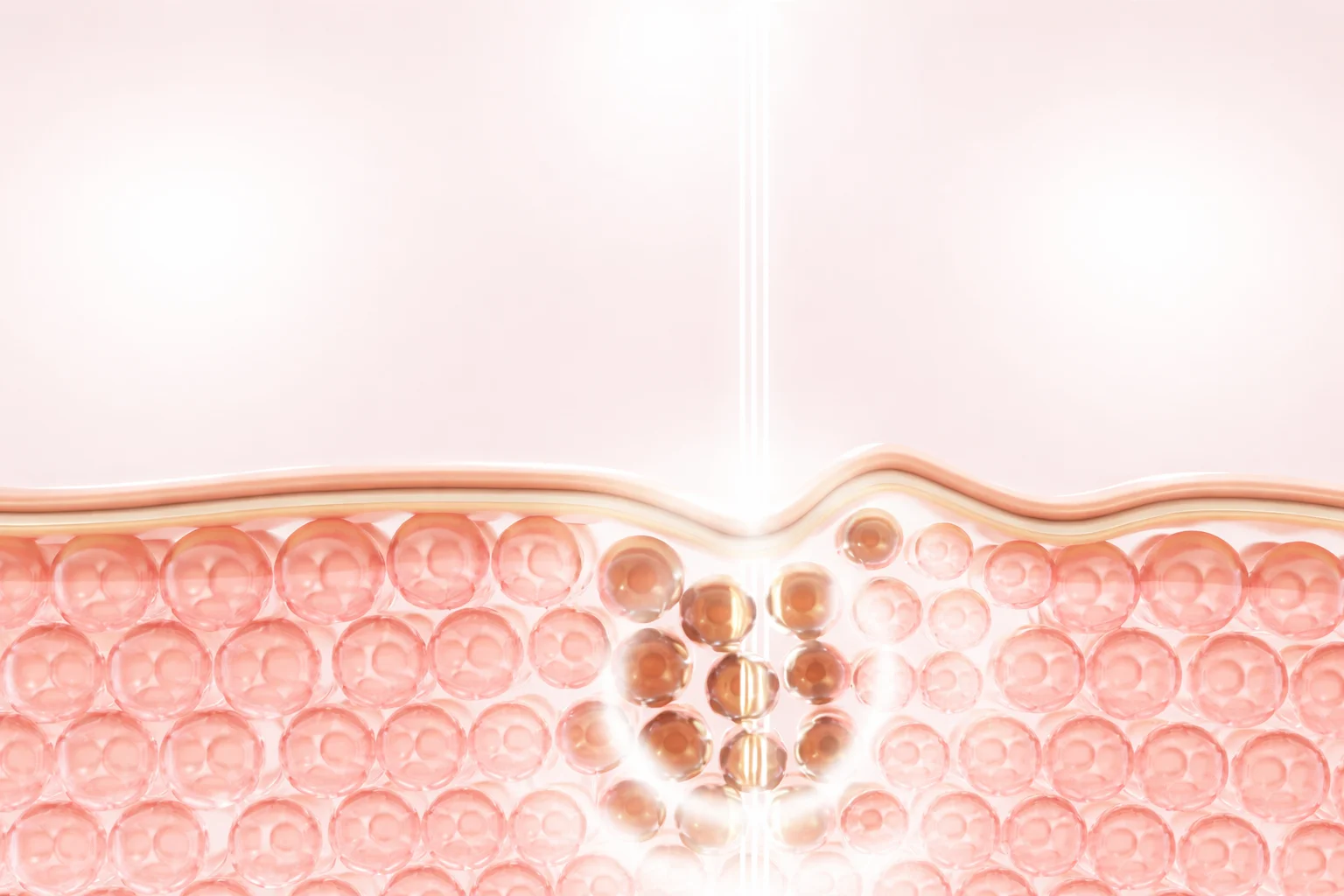
Low-fluence toning for melasma uses a 1064 nm Q-switched laser at low energy (roughly 3 J/cm² or less in the literature) over a wide spot, repeated at short intervals. The aim is not to destroy melanocytes but to break up only the melanosomes inside them. The reason for leaving the cells intact is plain — melasma-prone skin answers strong heat and inflammation by making more pigment.
So in melasma, turning the energy up does not translate into effect. Ablative lasers, which carry greater thermal injury, readily leave dyschromia, and low energy with short pulses is recommended instead; even at low energy, dyschromia is reported when intervals are too short. It is for the same reason that the literature places lasers after photoprotection and topical therapy have been settled first.
ABNOM, with pigment in the dermis, poses the opposite problem. Energy that disperses in the upper epidermis does not reach melanocytes in the papillary to mid dermis, so conditions that secure depth of penetration are required. This is why the same word — toning — cannot mean the same settings for the two lesions.
At The Other Dermatology, toning lasers of different character are combined — two or more within a single visit. Which devices are combined, and under what settings, depends on the depth and color of the lesion and on the condition of the skin, so it is decided at an in-person examination.
Internal blocking — tranexamic acid prescription
Oral melasma medication (tranexamic acid) helps systemically block pigment-forming signals and addresses the root pathway through which deep pigmentation rises.
Direct blocking — The Other Melasma Injection
Tranexamic acid is injected directly into melasma-prone areas to immediately suppress melanocyte activity.
Foundation renewal — Virtue RF
Radiofrequency energy remodels the aged dermal layer. When the skin’s foundation becomes stronger, melasma treatment results are maximized, with the added benefit of smoother skin texture.
Customized laser mix
For vascular melasma, vascular lasers are combined; for general melasma, precision toning is used to target pigment without unnecessary irritation.
What to expect and how long it takes
It helps to set expectations first. Melasma is a chronically relapsing pigmentary disorder, and the literature states that no treatment established to date removes it completely. The goal lies in how long a lowered tone can be held.
Studies of low-fluence 1064 nm Q-switched laser (42 studies including 19 RCTs, 1,736 patients) generally report courses of 5~15 sessions at 1~2 week intervals, most often 9~10. These numbers describe a course as designed in a study, not a session count recommended to an individual — the actual number and interval are set by watching how the lesion responds and what condition the skin is in.
With ABNOM, session count weighs more heavily on the outcome. In a retrospective study of 110 patients treated 2~9 times at 3~6 month intervals, good to excellent clearance was reported in 57.3% overall, and by session count in 28.1% at 2 sessions and 92.3% at 5 or more. Because the interval is 3~6 months, however, reaching 5 sessions takes more than a year, and the follow-up in that study was 6 months, so it carries no data on recurrence. These figures are likewise what was observed in a study, not what is promised to an individual.
Direction
Management over erasure
Interrupting the pigment-forming signal comes first.
Setting intensity
Age · skin tone
The darker the skin tone, the more conservative the energy design.
Caution
Over-toning
Repeated strong stimulation can instead make the pigment darker.
Aftercare
Sun protection is not care added on after a procedure; it is part of the treatment. Because light exposure is the factor most consistently identified in both the onset and the recurrence of melasma, the literature assumes year-round, long-term photoprotection regardless of season.
Evidence has accumulated that blocking ultraviolet alone is not enough. In a double-blind randomized trial in patients with melasma, the group using a product that blocks visible light as well as ultraviolet (containing iron oxide) saw greater pigment improvement from hydroquinone than the group using an ultraviolet-only product, and in a 2025 randomized, investigator-blinded study, worsening of pigment and color contrast across the summer was significantly reduced only with the tinted product. In a study of 39 French women, a broad-spectrum sunscreen containing iron oxide was reported to reduce recurrence after treatment. Experiments in healthy volunteers, in which visible light near 415 nm produced persistent pigmentation while 630 nm did not, are cited as the background to this difference.
That said, sunscreens are noted to fall short of their labeled performance in real use, because the amount applied and the frequency of reapplication are insufficient. Heat is managed alongside light — environments with repeated exposure to strong heat, such as cooking, baking, metalwork and glasswork, are named as factors that make melasma chronic. And because melasma-prone skin answers inflammation and heat by making pigment, rubbing the skin or adding harsh exfoliation after a procedure is also avoided.
What changes by area
The same brown reads differently depending on where it sits. The centrofacial pattern of melasma covers the forehead, cheeks, nose and upper lip while sparing the philtrum; the malar pattern concentrates on the cheeks and nose, and the mandibular pattern along the jawline. The literature describes the area around the eyes as spared in melasma, and pigment confined to the alae nasi or the root of the nose as very uncommon. ABNOM, by contrast, was described from its earliest reports as covering both sides of the forehead, temples, eyelids, cheekbones, alae nasi and the root of the nose. So when pigment sits on the eyelids or the alae nasi, possibilities other than melasma are kept on the table.
The area around the mouth is planned separately from the face as a whole. At The Other Dermatology as well, a procedure covering only the perioral area is kept separate from full-face treatment. How settings change by area is decided at an in-person examination.
Other conditions that look similar
Not every brown mark on the face is melasma. Freckles usually appear from the early teens as pale brown spots 1~3 mm across, scattered mainly over the cheeks and nose. Genetic predisposition weighs heavily and sunlight brings them out, so they characteristically darken in summer and fade in winter.
Solar lentigines (age spots) generally appear after the age of 40 on chronically photodamaged areas. Unlike freckles, they do not fade in seasons without ultraviolet stimulation but stay as they are, which is one point of separation; another is that they are discrete macules with relatively well-defined borders, unlike melasma, which runs together as though bleeding outward. The three form pigment in different ways, so they are approached differently, and when they are mixed on one face the visit begins by sorting out which is which.
Frequently asked questions
Can melasma be removed completely?
The literature states that no treatment established to date removes melasma completely. Melasma is classified as a chronically relapsing condition, and the aim of treatment is to hold a lowered tone. Reports that recurrence is common once maintenance therapy stops appear repeatedly.
I have heard lasers make melasma darker. Is that true?
It can happen. Melasma-prone skin answers heat and inflammation by making more pigment, so if the energy is excessive or the interval too short, rebound hyperpigmentation can occur. That is the reason for repeating at low energy over a wide spot — and even then the risk does not disappear. Settings have to be adjusted while watching the response.
How do I know whether it is melasma or ABNOM?
Color, location and time of onset are the clues. A blue-brown or grey-blue cast, a pattern scattered in discrete specks, and sites melasma rarely reaches such as the eyelids, temples and alae nasi are described in the literature as findings that suggest dermal pigment. The two often overlap, however, and appearance alone does not separate them. Dermoscopy helps, while Wood's lamp examination is reported to be about 46% accurate at distinguishing pigment depth and is not used on its own. **The final distinction is made by examining the lesion directly.**
Can melasma and ABNOM occur together?
They can. In a retrospective study of 110 patients treated with a laser for ABNOM, those who also had melasma were analyzed separately, and post-inflammatory hyperpigmentation in that group was 33.3%, against 5.4% in those without melasma. When the two overlap, which is addressed first and under what settings changes.
Does diligent sunscreen use alone help?
Photoprotection is not an adjunct but an axis of treatment. In randomized trials, an iron oxide-containing product blocking visible light as well as ultraviolet was more favorable for pigment improvement than an ultraviolet-only product, and it was the tinted product that reduced worsening across the summer. It is noted, however, that performance falls short of the label when the amount applied and the frequency of reapplication are insufficient, so applying enough and reapplying have to go together.
Can it be treated during pregnancy?
The agents available during pregnancy and breastfeeding are limited. Hydroquinone is described as not used in this period because safety evidence is insufficient, and for oral tranexamic acid a screening history for thromboembolic disease comes first. Photoprotection is often placed at the center during this time, and the timing of treatment is decided at an in-person examination.
This page is general information about a treatment and is not a diagnosis or a recommendation. The right choice differs by skin condition, so treatment is decided after an in-person examination. Individual results vary.
References
- Melasma StatPearls
- Melasma DermNet NZ
- Update on melasma — Part II: Treatment Dermatol Ther (Heidelb) 2022
- Pathogenesis of melasma explained Int J Dermatol 2025
- Acquired bilateral nevus of Ota-like macules: a case report NCBI PMC 2024
- A comparative study of dermatoscopic features of melasma and Hori's nevus in Asian patients J Clin Aesthet Dermatol
- The low-fluence Q-switched Nd:YAG laser treatment for melasma: a systematic review NCBI PMC
- A retrospective study of 1064-nm Q-switched Nd:YAG laser therapy for acquired bilateral nevus of Ota-like macules NCBI PMC
Related information
Treatment pages
- Melasma treatment at The Other — How The Other Dermatology approaches melasma
- ABNOM (acquired bilateral nevus of Ota-like macules) treatment — The approach to pigment that sits in the dermis
- Lentigo (age spot) treatment — Pigment approached differently from melasma