
Thermage FLX
A lifting treatment that cools the surface while delivering radiofrequency (RF) energy into the dermis below, so the skin's own collagen can rebuild.
Illustration, not a photograph, of a cross-section of the skin during a Thermage FLX treatment. From the top: epidermis, dermis, fat layer, SMAS layer and muscle. A wide, flat tip rests on the skin surface and cools it, and the dermis below is warmed as a band. The heat is not gathered into a single point: the layer is warmed gently along its width. No depth figures are shown in this illustration. Layer thicknesses and the extent of the warming are illustrative.
The illustration shows where the layers sit. Layer thicknesses and the extent of the warming are illustrative.
Treatment time
30–60 min
Depending on the area treated
When results appear
2–6 months
They build up gradually
Downtime
Little to none
Back to your day straight away
During treatment
Cooling and vibration
They protect the surface
Thermage FLX at a glance
Thermage FLX is a lifting device that delivers radiofrequency (RF) energy into the dermis. It cools the surface and heats the tissue below, so the skin's own collagen can rebuild.
- A session takes 30–60 minutes depending on the area.
- The radiofrequency energy reaches the dermis while the surface stays cool.
- There are almost no limits on activity afterwards, though temporary redness or swelling can occur.
- The manufacturer says one treatment delivers results that keep improving over two to six months.
- How long it lasts depends on your skin and how you age; the manufacturer says one to two years.
Who is Thermage FLX for?
Skin firmness and treatment areas
My skin has lost firmness overall.
Radiofrequency heats the dermis, so it works on the skin's own firmness and texture. Lifting sagging from deep down is the job of devices that reach deeper, so if the cheeks are already sagging deeply, another device may suit you better. We decide that together at a consultation.
I'm worried my cheeks will look hollow.
Because radiofrequency heats a volume of tissue, there can be temporary swelling and surface irregularities afterwards, and less commonly lumps under the skin, mostly seen in the neck. If the cheeks are already sagging a lot, we sometimes plan it together with a device that reaches deeper. We look at your face first at the consultation.
I have fine lines around my eyes. Can you treat the eyelids too?
Wrinkles around the eyes, including the upper and lower eyelids, are among the areas in the manufacturer's clearance. The eye area uses the 0.25 cm² tip, and the full-size tip is not used over the eye. Which areas to treat is decided at your consultation.
It's my first time, so I'm not sure what to expect.
It runs consultation, AI analysis, pain control and treatment, in that order. Stamping is the default, with a minimal amount of sliding added on delicate areas such as around the eyes and mouth. A dermatologist performs the treatment from start to finish.
How does Thermage FLX work?
It cools the surface and heats the dermis
It cools the surface and puts heat into the dermis below, so the skin's own collagen can rebuild.
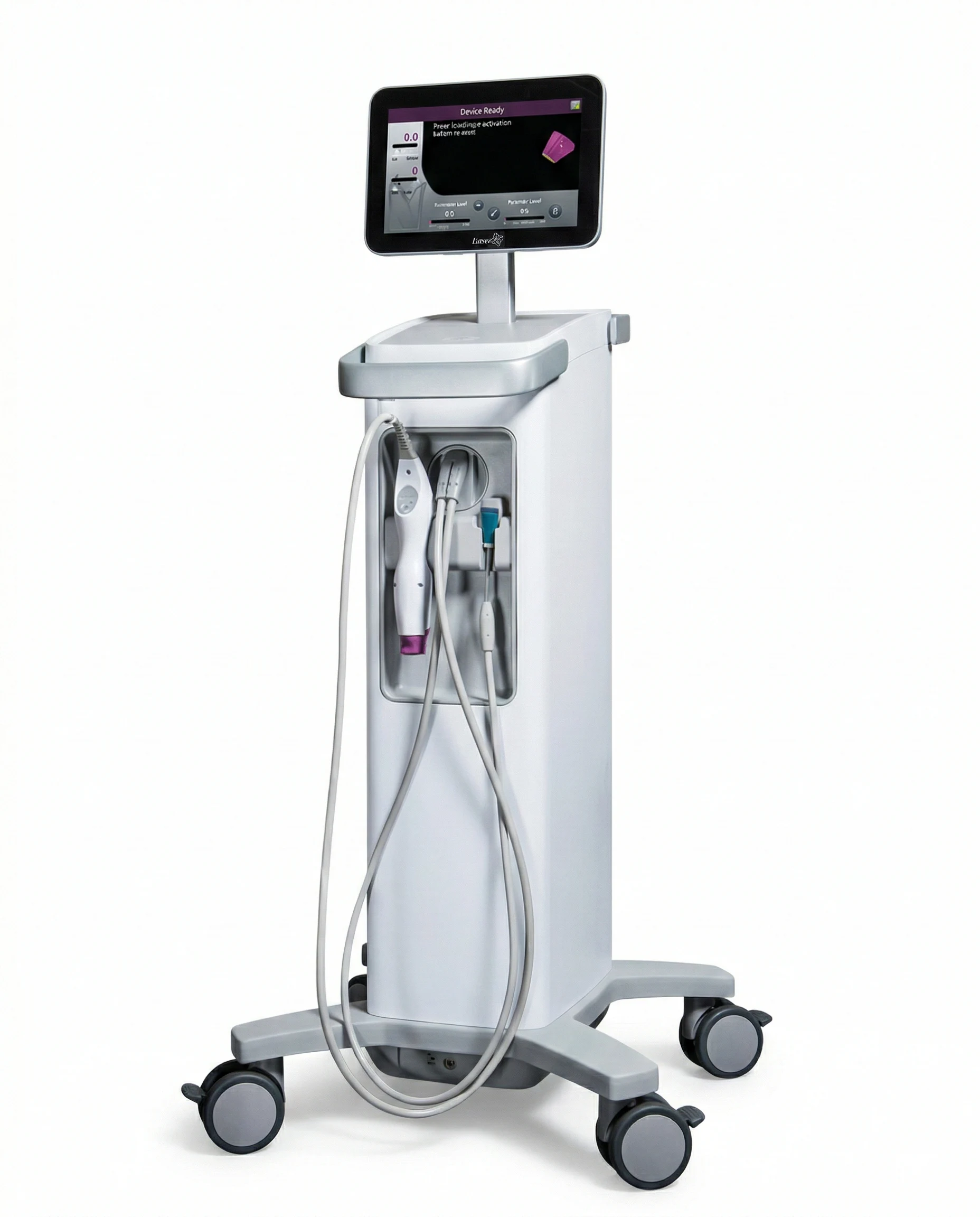
The handpiece is held against the skin to deliver radiofrequency energy into the dermis. The surface is cooled while the tissue below is heated.
The epidermis stays protected while the tissue below is heated selectively. The body starts a repair response, and collagen is rebuilt in that process.
The surface is cooled
Cooling and vibration are built into the handpiece, so the surface stays protected throughout the treatment.
Selective heating in the dermis
It heats the dermis below without touching the epidermis. It is not focused on a single point but heated as a volume.
Output follows your skin
The system and the handpiece monitor skin contact, and energy delivery keeps adjusting to the skin's needs.
Thermage FLX and the other lifting devices: what is the difference?
They all lift with heat, but the energy and the layer it reaches differ. Thermage FLX heats the dermis broadly, as a volume.
Thermage FLX heats the dermis broadly as a volume. Sofwave spreads parallel ultrasound in the dermis at 1.5 mm, Ultherapy Prime focuses ultrasound on a single point and, depending on the transducer, can reach the SMAS layer, and Onda acts on the dermis and the fat layer with microwave.
Illustration, not a photograph: the Thermage FLX cross-section drawn to the same layer reference. From the top it shows the epidermis, dermis, fat layer, SMAS layer and muscle. A wide, flat tip rests on the surface and cools it, and the dermis below is warmed as a band. No depth figures are shown in this section. The right-hand section shows the device you select on the same layers.
In the right-hand Sofwave section, seven parallel beams form thermal columns in the dermis at a depth of 1.5 mm. No depth figures are shown in this section. The two sections are drawn on the same layer reference; this is an illustration, not a photograph.
In the right-hand Ultherapy Prime section, the ultrasound from each transducer converges on a single point and forms a point of thermal coagulation at 1.5, 3.0 and 4.5 mm; 4.5 mm lies in the SMAS layer. No depth figures are shown in this section. The two sections are drawn on the same layer reference; this is an illustration, not a photograph.
In the right-hand Onda Lifting section, the microwave does not converge on a point but spreads widely across the dermis and the fat layer. No depth figures are shown in this section. The two sections are drawn on the same layer reference; this is an illustration, not a photograph.
Both cross-sections are drawn to the same layer reference. Layer thicknesses and the extent of the warming are illustrative.
How do the energy and the layer reached differ by device?
They all lift with heat, but the layer heated and the way it is delivered differ, and Thermage FLX heats the dermis broadly, as a volume.
| Device | Energy | Acts on |
|---|---|---|
| Thermage FLX | Radiofrequency (RF), heated as a volume | Across the dermal layer |
| Sofwave | Ultrasound (parallel beams) | Dermal layer at 1.5 mm |
| Ultherapy Prime | Focused ultrasound (HIFU), focused to a point | SMAS layer at 4.5 mm, dermal layer at 3.0 and 1.5 mm |
| Onda Lifting | Coolwaves™ microwave | Fat cells beneath the skin and dermal collagen |
How does a Thermage FLX session run?
Steps and timing
Consultation
We look at your skin, the areas to treat and any earlier treatments before deciding whether it suits you.
AI analysis
The whole face is scanned with AI to find where firmness has fallen most now and where ageing is likely to progress, then energy level and shot count are set for each area to build a shot map.
Treatment
Stamping is the default, with a minimal amount of sliding added on delicate areas such as around the eyes and mouth. The tip is held firmly on each point, which reduces energy loss. A dermatologist performs it, and it takes 30–60 minutes.
Afterwards
You can go back to your day. The treated area may look pink or slightly swollen for a while.
Does Thermage FLX hurt?
Pain control is planned before the treatment
How much you feel during treatment differs from person to person. So The Other plans pain control before the treatment starts, not after discomfort begins.
Step-by-step pain control
Before treatment, a high-concentration numbing cream reduces surface sensation. Nerve block anaesthesia, area-specific pain-relief injections and sedation are added in steps as needed. Which steps to use is decided with the dermatologist at your consultation.
What the device does
The manufacturer describes a brief heating sensation when the tip touches the skin, followed by a cooling sensation. Vibration, it says, also helps with comfort.
An honest limit
It is not a painless treatment. The manufacturer's safety information lists mild to moderate pain in the treated area as the most common reaction during treatment. If it hurts, tell us there and then, so the output can be adjusted.
When do Thermage FLX results appear?
They appear gradually over two to six months rather than on the day, and the pace differs from person to person.
Right after
You can go back to your day. Temporary redness or swelling can occur: redness usually settles within 24 hours, and swelling usually within 5 days, though it can last a few weeks.
2–6 months
As the skin's own collagen rebuilds, visible change builds up.
After that
How long it lasts depends on your skin and how you age; the manufacturer says one to two years. Many people continue with maintenance treatments.
Why does it take months?
When heat reaches the dermis the body starts a repair response, and collagen is rebuilt in that process. Making new collagen takes time.
How many sessions do I need?
The manufacturer says one treatment delivers results, which keep improving over the following two to six months. Many people then keep up with maintenance treatments.
The manufacturer's official page describes results continuing to improve over the two to six months after treatment.
We do not publish before-and-after photos on this page. How skin responds depends on skin thickness, skin condition and the area treated, so a photo cannot show what your own skin will do.
What are aftercare and downtime like after Thermage FLX?
There are almost no limits on activity afterwards, and you can return to your day straight away. The treated area may look pink or slightly swollen for a while.
How does my skin look right after?
Redness usually settles within 24 hours and swelling within 5 days. Less commonly, surface irregularities can last a month or more, or lumps can form under the skin; these are mostly seen in the neck and usually resolve within one to two weeks.
What should I pay attention to?
Keep up broad-spectrum sunscreen and ordinary skin care after the treatment too.
What if I notice something less common?
Numbness or tingling can occur. It usually settles within days, though it can last a few weeks, so if it persists, talk to the doctor who treated you.
Aftercare is explained at your visit according to your skin condition.
What to tell us before a Thermage FLX treatment
These are the manufacturer's contraindications and the situations they have not studied. If any of them apply to you, tell us before treatment.
When not to have the treatment
- A cardiac pacemaker, cardioverter, defibrillator or other electrical implant.
Situations they have not studied
- Over areas injected with fillers or similar products; cold sores, genital herpes, or areas with permanent make-up or tattoos.
- Children, pregnancy, breastfeeding, diabetes, autoimmune disease such as lupus, epilepsy.
Less common reactions
- Burns, blisters, scabs and scarring; surface irregularities a month or more.
- Numbness, tingling or temporary paralysis can occur.
- Nodules form mostly in the neck and clear within one to two weeks. The skin may darken, but it fades within a few months.
Thermage FLX FAQ: frequently asked questions
Comparing and choosing
What kind of treatment is Thermage FLX?
It is a non-invasive lifting treatment that delivers radiofrequency (RF) energy into the dermis. The surface is cooled while the tissue below is heated, so collagen rebuilds. The clearance lists a maximum average power of 400 W and a frequency of 6.78 MHz.
How are Thermage FLX and Ultherapy different?
They differ in the type of energy and the layer they reach. Thermage FLX heats the dermis broadly with radiofrequency, while Ultherapy Prime focuses ultrasound on a single point and, depending on the transducer, reaches the SMAS layer. When your concerns differ, the right device differs too, and we decide that together.
And how is it different from Sofwave?
Sofwave also uses ultrasound, but it forms columns of heat side by side 1.5 mm deep in the dermis, while Thermage FLX heats a volume with radiofrequency. Both keep the surface cool while heating the layer below.
Treatment day
How long does a session take?
About 30 to 60 minutes, depending on the area treated.
Does it hurt?
How much you feel differs from person to person. The manufacturer says the device's cooling and vibration help with comfort, while its safety information lists mild to moderate pain in the treated area as the most common reaction during treatment. At The Other, pain is managed in steps, from numbing cream to sedation.
Are there limits on what I can do that day?
The manufacturer says most people return to their regular activities immediately after treatment and that no special care is needed, though the treated area may look pink or slightly swollen.
Results and sessions
When do results show?
They build up gradually over two to six months rather than on the day.
How many treatments do I need?
The manufacturer says one treatment delivers results, which keep improving over the following two to six months. Many people continue with maintenance treatments.
How long do results last?
It depends on your skin and how you age; the manufacturer says one to two years.
Safety and suitability
Is it cleared by the US FDA?
It was cleared under US FDA 510(k) K170758 on 22 September 2017. A 510(k) checks that a device is substantially equivalent to a legally marketed one for the same use; it is not a clearance that promises what the treatment will do for you.
Can I have it over an area with filler?
The manufacturer states they have not studied use over areas injected with fillers or similar products. One small study (six people) reported no change in shape when radiofrequency was delivered two weeks after injection, with slightly more transient pain, but six people is a thin basis. Tell us about earlier treatments before your session.
Find out in a consultation whether Thermage FLX suits your skin
At The Other Dermatology in Gangnam, Seoul, we look at your skin, the areas to treat and any earlier treatments, then tell you whether Thermage FLX suits you.
Or reach us another way
Chat WhatsApp Facebook Messenger LINE Instagram Email Phone KakaoTalk Naver TalkTalk
Back to top