
Pigmentation • Rosacea
Facial Flushing: What It Is and How It Differs from Rosacea
When the face reddens easily, most people call it flushing. But the same redness can be two different things: a transient reaction that settles once the trigger is gone, or rosacea — a chronic inflammatory disease in which the redness does not settle and progresses over years. This page covers why the two are confused, where they diverge, and the point from which the answer has to come from an examination rather than from watching and waiting.
What is Facial Flushing?
Your cheeks look hot and red in the mirror. Your face heats up the moment you start speaking in front of other people. A spicy meal or a single drink turns you red down to the neck. What people describe when they come in about flushing sits mostly inside that range.
In medical terms, flushing is what happens when the blood vessels close to the skin surface widen for a time, so more blood flows through them and the skin looks red. In a healthy person the reaction is usually temporary. Heat, heightened emotion, exercise, and a range of foods and drinks are common triggers, and the redness disappears once the vessels narrow again.
That is why flushing itself is a symptom, not a disease name. Menopausal hot flushes; medications such as niacin, calcium channel blockers, and PDE-5 inhibitors; thyroid dysfunction; and, less commonly, systemic conditions such as carcinoid syndrome, systemic mastocytosis, and pheochromocytoma all present as a face that turns red. Redness on its own does not narrow the cause.
Some repeated flushing is rosacea. The Korean Dermatological Association describes rosacea as a chronic skin disease of the central face — around the nose and across the cheeks, chin, and forehead — characterised by persistent erythema, papules and pustules, recurrent flushing, and telangiectasia. It is most common in people in their 30s to 50s and occurs more often in women, although severe disease appears mainly in men, and it does not resolve on its own; it relapses and remits.
The reason rosacea is not explained simply as "vessels that dilate easily" lies in its pathophysiology. Increased expression of channels such as TRPV-1 in sensory nerves and keratinocytes makes erythema and flushing easier to provoke, and overexpression of TLR-2 activates innate immunity, raising LL-37 (cathelicidin) and with it mast cell activity. An increase in Demodex folliculorum is also observed in affected skin, though the causal relationship is still not clear. In other words, chronic inflammation is layered on top of a vascular reaction.
How is it different from Rosacea?
The main reason the two are confused is that rosacea also begins as intermittent flushing. As the Korean Dermatological Association describes it, rosacea starts with intermittent flushing, then as it progresses leaves persistent erythema, telangiectasia, and inflammatory papules behind, and in severe disease goes on to large inflammatory nodules and tissue overgrowth. So if you look only at how it appears at the start, physiological flushing and early rosacea look almost the same.
The point where they diverge is persistence. The global rosacea consensus panel (ROSCO) agreed that persistent centrofacial erythema that periodically intensifies with triggers is by itself a diagnostic feature of rosacea (17 of 17 in agreement). Flushing, telangiectasia, inflammatory papules and pustules, and ocular signs, by contrast, are not diagnostic on their own; rosacea is considered when two or more of them occur together. That the location is the central face is also essential to the diagnosis, with 17 of 18 in agreement.
The distinction matters in practice because the response to each is the opposite. Transient flushing is largely managed by finding and avoiding your own triggers. Rosacea, however, leaves erythema and inflammation that progress even when triggers are avoided. The more damaging error runs the other way — when rosacea is taken for simple flushing or for acne and an over-the-counter steroid ointment is applied to the face, the literature states plainly that topical corticosteroids cause rebound flares and rosacea-like perioral dermatitis in rosacea. The practical value of this distinction is that the wrong name leads to the wrong drug.
Rosacea (the chronic disease)
- How long the redness lasts
- Redness on the central face remains even after the trigger is gone. This 'persistent centrofacial erythema' is a diagnostic feature on its own
- What appears alongside it
- Papules and pustules, telangiectasia, ocular signs, and phymatous change may accompany it. Burning, stinging, oedema, and dryness are secondary features
- Distribution
- Concentrated on the central face — around the nose and across the cheeks, chin, and forehead. The centrofacial location is essential to the diagnosis
- Course over time
- Does not resolve on its own, relapses and remits, and if left alone can progress to telangiectasia, phymatous change, or ocular involvement
- What is done about it
- Beyond trigger management, long-term control is needed, including topical and systemic medication and vascular lasers
Facial Flushing
- How long the redness lasts
- Once the trigger is gone and the vessels narrow again, the skin returns to its original colour and nothing is left behind
- What appears alongside it
- Apart from the redness and the sensation of heat, no lesion remains
- Distribution
- Spreads more widely across the cheeks, neck, and chest, then subsides together
- Course over time
- The pattern of reddening repeats whenever a trigger is present, but it does not lead on to persistent erythema or to lasting findings such as papules
- What is done about it
- Largely managed by identifying and avoiding your own triggers
The Other's Cause-Specific Treatment Design
Treatment for the redness divides into three lines — the vessels that have already dilated, the inflammation that dilates them, and the lifestyle factors that keep provoking both.
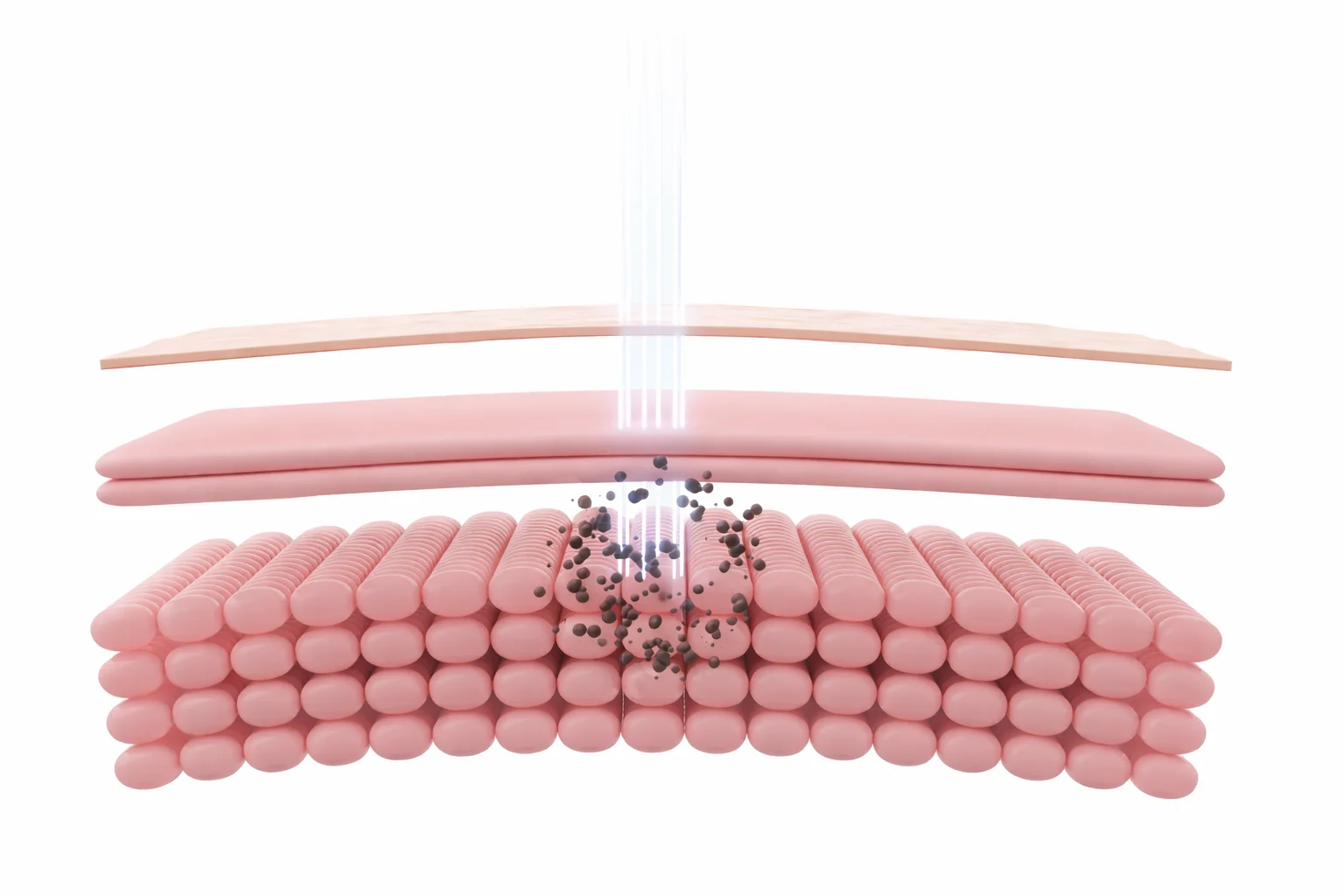
What the vascular laser handles is the first of these. The principle is selective photothermolysis. Oxyhaemoglobin in the blood preferentially absorbs light of particular wavelengths and converts it to heat; that heat is transferred to the vessel wall and causes coagulation and vessel closure. Short pulses at high power are central to this approach, so that heat does not spread into the surrounding tissue. The absorption peaks of oxyhaemoglobin are at 418, 542, and 577 nm, and in clinical practice the 532 nm and 595 nm ranges are the ones mainly used. Shorter wavelengths are absorbed well but do not penetrate deeply, which can be a disadvantage in thicker lesions; 595 nm emerged as a wavelength offering deeper penetration.
In the literature, the pulsed dye laser (PDL) and KTP are both used to treat persistent erythema and telangiectasia. In a prospective controlled study comparing 532 nm KTP with 595 nm PDL (n=45, mean age 51), the reduction in erythema was significant with both devices and the effect was comparable. Pain during treatment, however, was lower with KTP — 2.5 versus 4.1 for PDL on a 10-point scale — and meaningful purpura was observed only in the PDL group. That much is a comparison between devices in the literature. Vascular lasers are used in the treatment of flushing at The Other Dermatology; which device and wavelength are used, and how the detailed settings are chosen, depend on the lesion and are determined at the consultation.
What the laser cannot reach is handled by medication. The literature separates the drugs used for persistent erythema, those used for papules and pustules, and the oral drugs used when inflammatory lesions are numerous. What is used and in what order depends on the phenotype — whether vascular dilatation or papulopustular disease predominates — so it is settled at an in-person examination.
The third line is triggers. In a patient survey by the National Rosacea Society (n=1,066), the factors identified were sun exposure 81%, emotional stress 79%, hot weather 75%, wind 57%, exercise 56%, and alcohol 52%. Because the list differs from person to person, keeping a record of your own triggers for at least two weeks is treated as part of the treatment itself.
When the skin barrier has broken down
Rather than starting with a laser, we first restore the ground — raising the skin's hydration and calming it through treatments such as LDM (water-drop ultrasound).
When sebum production and inflammation are marked
PTT or skin botox is used to regulate overactive sebaceous glands and improve the inflammatory environment, lowering how often the flushing occurs.
When vessels have already dilated
A precise vascular laser is used to selectively destroy only the abnormally dilated vessels.
When the skin itself is thin and reactive
Skin boosters such as Lituo (hADM) or Rejuran are used to reinforce the thickness of the dermis and raise its regenerative capacity, building skin that withstands external stimuli.
What to expect and how long it takes
Rosacea is a chronic disease that does not resolve on its own and that relapses and remits. The aim of treatment is therefore not to remove the redness but to bring the level of erythema and inflammation down and then hold it there. The literature reports that where clinical signs reached complete clearance, the interval before relapse was longer and the improvement in quality of life was greater.
The actual number of sessions and the interval between them, and how long it takes for the reaction after a treatment to settle, vary with the type and extent of the lesion and with the wavelength and settings used. This page does not put numbers to those values — a number stripped of its conditions reads as a promise, and the right place to set them is an in-person examination of the skin. Individual results vary.
Order of treatment
Cause first
We look at whether the barrier, the inflammation, or the vessels comes first, and design from there.
Nature of the disease
Controlled, not cured
It does not resolve on its own; it relapses and remits.
What must not be missed
Ocular signs
Left unattended, ocular involvement can affect vision.
Aftercare
Ultraviolet light comes first. Sun exposure was the most frequently identified trigger in the patient survey (n=1,066), at 81%. The literature advises using an inorganic sunscreen containing zinc oxide or titanium dioxide at SPF 30 or above. After a vascular laser the same care is needed again, this time to reduce post-inflammatory hyperpigmentation.
Cleansing and moisturising stay simple, in the direction of less irritation. Use a gentle cleanser, moisturise often, and avoid exfoliants and products containing alcohol. Because damage to the skin barrier is itself counted among the aggravating factors in rosacea, layering on strong products to clear the redness faster works in the opposite direction.
Do not reach for a leftover steroid ointment and apply it to the face when the redness worsens. Topical corticosteroids can cause rebound flares and rosacea-like perioral dermatitis in rosacea, so rather than stopping or continuing them on your own, a tapering plan is set at an examination.
What changes by area
Nose — phymatous change (rhinophyma), in which sebaceous gland hypertrophy and fibrosis thicken the tissue of the nose, is a different stage. In the ROSCO consensus, phymatous change is clear enough to be treated as a diagnostic feature of rosacea in its own right, and it does not reverse with lasers that target vessels. In the literature, ablative lasers such as CO2 and erbium are used at this stage. A nose that is red and a nose that has thickened sit on different treatment axes.
Eyes — ocular involvement is reported in more than half of rosacea patients, with figures ranging widely from 6% to 58% depending on the survey. Bilateral chronic blepharitis and meibomian gland dysfunction are characteristic, and in 15% the ocular symptoms appear before the skin symptoms. If the eyes feel dry or gritty and the lid margins are red, this is not within the range that skin treatment alone resolves. The literature recommends an accompanying ophthalmological assessment in such cases. The Korean Dermatological Association states explicitly that there is a risk of blindness where ocular disease is a complication.
Other conditions that look similar
Not every red face is flushing or rosacea. The differential list in the literature includes acne, demodicosis, seborrhoeic dermatitis, eczema including contact dermatitis, perioral dermatitis, steroid-induced rosacea, dermatomyositis, systemic lupus erythematosus, and drug reactions. Two distinguishing points appear often in the literature — papulopustular rosacea has no comedones, which separates it from true acne, and seborrhoeic dermatitis is separated by whether scale sits on top of the erythema.
Sometimes the cause lies outside the skin. Menopausal hot flushes; medications such as niacin, calcium channel blockers, and PDE-5 inhibitors; thyroid dysfunction; and, less commonly, carcinoid syndrome, systemic mastocytosis, pheochromocytoma, and medullary thyroid carcinoma all present as flushing. If the redness comes with persistent watery diarrhoea, wheezing on breathing, severe headache accompanied by high blood pressure, or hives spreading beyond the face, those are signals that testing beyond the scope of dermatology is needed.
Frequently asked questions
My face reddens often — when should I have it examined?
The test is whether redness on the central face remains after the trigger is gone. The expert consensus (ROSCO) treats persistent centrofacial erythema that periodically intensifies as a diagnostic feature of rosacea in its own right. If any of the following overlap with it — small papules or pustules, visible fine vessels, a gritty feeling in the eyes — the picture is clearer still. If instead it settles within a few minutes and leaves nothing behind, keeping a trigger record is useful. But early rosacea also begins as intermittent flushing, so while you keep that record, watch for whether the redness starts to stay. If you cannot tell, it is quicker to have it checked at an examination.
Does rosacea go away?
The Korean Dermatological Association explains that rosacea does not resolve on its own and that it relapses and remits. It is better understood as a condition that is controlled than one that is eliminated. That said, the literature reports that where clinical signs reached complete clearance, the interval before relapse was longer and the improvement in quality of life was greater — so where the goal of management is set changes the course. Individual results vary.
Can I use a steroid ointment I bought at the pharmacy?
Topical corticosteroids are avoided on a face with rosacea. The literature states that topical corticosteroids cause rebound flares and rosacea-like perioral dermatitis in rosacea. If you have already been applying one for a long time, a rebound flare on stopping abruptly is common, so rather than adjusting it yourself it is safer to set a tapering plan at an examination.
I heard rosacea is rare in Koreans.
It is true that it is more common in lighter skin, but it is not a rare condition in Korea. Rosacea was diagnosed in roughly 1% of patients visiting one clinic in Seoul, and among 168 Korean rosacea patients about 40% had Fitzpatrick type IV or V skin. A tendency for diagnosis to be delayed in darker skin, where erythema is less visible, is also reported. These are single-centre data and cannot be read as community prevalence.
Is it enough to give up spicy food and alcohol?
Triggers differ from person to person. In a survey of 1,066 patients the factors identified were sun exposure 81%, emotional stress 79%, hot weather 75%, wind 57%, exercise 56%, and alcohol 52%. Food and alcohol are part of the list, and the item named most often was sunlight. Building your own list comes first, so recording when the redness occurs for at least two weeks is treated as the starting point of treatment.
Are visible fine vessels and a broadly red face the same problem?
They overlap, but they are not the same. Visible telangiectasia consists of individual vessels that have thickened, while broad diffuse redness is a state produced by dilatation of superficial vessels together with inflammation. In the literature vascular lasers are used for both, but the choice of wavelength and settings differs depending on which is the predominant finding. That is why the same word 'flushing' is looked at differently at an examination.
This page is general information about a treatment and is not a diagnosis or a recommendation. The right choice differs by skin condition, so treatment is decided after an in-person examination. Individual results vary.
References
- 주사(rosacea) Korean Dermatological Association
- Rosacea DermNet NZ
- ROSCO panel — phenotype-based diagnosis and treatment recommendations Br J Dermatol 2017;176:431
- Rosacea StatPearls
- Global epidemiology and clinical spectrum of rosacea, highlighting skin of color J Am Acad Dermatol 2018
- Topical corticosteroid-induced rosacea-like dermatitis: a clinical study of 110 cases PubMed
- Steroid rosacea DermNet NZ
- Lasers for vascular lesions: standard guidelines of care IJDVL
- Ocular injury in cosmetic laser treatments of the face J Clin Aesthet Dermatol
- Underlying etiologies of cutaneous flushing Dermatology Advisor
- New survey pinpoints leading factors that trigger symptoms National Rosacea Society
Related information
Treatment pages
- Acne marks — treating the red and brown marks acne leaves behind — If the red marks are what acne left behind
- Rosacea flushing treatment — vascular type and papulopustular type — How The Other Dermatology separates flushing by type
- Melasma — diagnosis and treatment of pigmentary disease — When redness and brown pigment are present together