
Press
2026.09.02
Sofwave: Firmness Without Hollowed Cheeks — Dr. Lee Seung-joo, The Other Dermatology Clinic
People&Clinic · Aug 31, 2026, 21:00 · By Jin-ah Moon
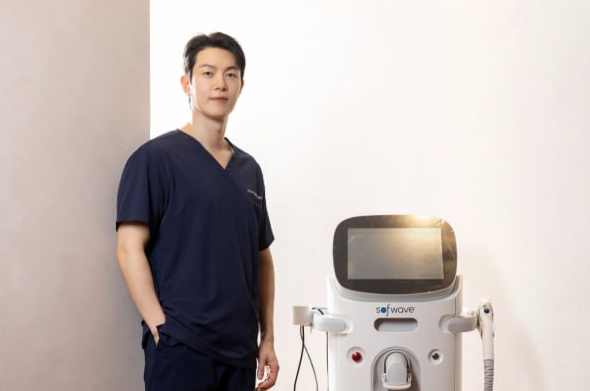
Three months after opening, The Other Dermatology Clinic has seen demand for Sofwave grow and recently added a second unit, bringing the total to two. Sofwave precisely targets only the mid-dermis at 1.5 mm, which is why it is regarded as a suitable lifting option for high-end anti-aging patients who worry about side effects such as hollowed cheeks or a "peanut-shaped" face. We spoke with Dr. Lee Seung-joo about why the clinic adopted Sofwave, who it is mainly for, the technique behind the treatment, and how it is combined with other procedures.
When and why did you adopt Sofwave?
We brought it in the moment the clinic opened. The side effects that patients seeking high-end anti-aging treatments worry about most these days are hollowed cheeks and a worsening "peanut-shaped" face. Sofwave uses SUPERB™ (Synchronous Ultrasound Parallel Beam) technology to target the mid-dermis at exactly 1.5 mm, so we judged that it could improve skin firmness while reducing concerns about fat-layer damage or cheek hollowing. Demand has been high recently, so when we welcomed an associate doctor we added one more unit, and we now run two.
Which patients do you mainly treat? How does the target patient differ from HIFU devices such as Ultherapy?
This follows on from the previous answer. First, people with thin skin. Second, people who are strongly concerned about cheek hollowing. Third, people bothered by fine lines around the mouth and on the neck. And finally, people whose dermal elasticity has declined overall. HIFU such as Ultherapy goes deep to the SMAS layer and lifts the sagging itself, whereas Sofwave remodels collagen and elastin in the mid-dermis to improve the skin's own firmness, texture, and fine lines. So HIFU suits those more concerned about deep sagging, and Sofwave suits those with thin skin who are more concerned about fine lines and loss of elasticity. Rather than competing, the two are complementary treatments that target different depths.
Do patients come in specifically asking for Sofwave?
Yes, more than you might expect. Overseas it is widely known as the lifting treatment Kim Kardashian had, so quite a few patients, both Korean and international, come in saying from the start, "I want Sofwave." Apart from Ultherapy, Thermage, and Onda, it is unusual to see this many patients name a specific device when they visit. It shows how high the device's global recognition is.
The main treatment areas are the cheeks, jaw, under-eye area, and neck. Does satisfaction differ by area, and are there other areas where it can be used?
I use it most for fine lines around the mouth, and satisfaction is highest there too. There is an anatomical reason for this. Ultherapy's 3.0 mm and 4.5 mm transducers are difficult to use right beside the mouth because of the risk of injuring the marginal mandibular nerve. That leaves a blind spot that conventional HIFU does not cover well, but because Sofwave targets only 1.5 mm, we can focus on this area. When I explain this difference, patients understand immediately, which helps a great deal in consultations. Beyond that, the under-eye area, the submental region, and the neck are all FDA-cleared areas, so I use it broadly. Because it targets the dermis, I think Sofwave's strengths show best in thin, delicate areas.
After using it in practice, was there any technique that turned out to be more important than you first expected?
The most important thing is contact. This is true of other lifting devices as well, but with Sofwave, welts form easily if the applicator is not in full contact with the skin. On strongly curved areas such as the jawline in particular, the key is to finely adjust the angle of the applicator along the curve of the skin while keeping the cooling gel in full contact across the surface. At the same time, I tension the skin by pulling it flat so that every sensor on the tip contacts the skin evenly. Only then is energy delivered precisely to the intended depth and the epidermis properly protected. The other point is shot design. Even with the same number of shots, results differ depending on where and in which direction the energy is placed. Rather than simply treating uniformly by the manual, I have patients make a range of expressions, then vary the direction of each pass according to the shallow wrinkles and aging patterns that appear and the structure of the face to secure coverage. I believe this is what determines satisfaction.
How do you manage pain?
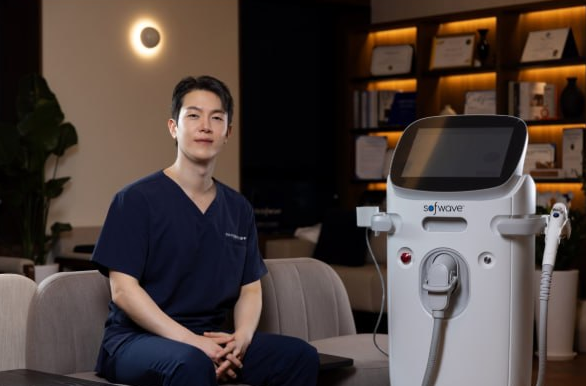
I combine two approaches. One is to hand patients the portable fan that Sofwave provided with the device. As the patient directs the cool air themselves during treatment, it not only relieves pain but also gives them an active way to ease discomfort in the areas that hurt most, which has a significant calming effect. The other is a nerve block. I always perform one. Sofwave has a built-in cooling system, Sofcool, so it is not a particularly painful treatment, but patients need to be comfortable and free of pain concerns for us to deliver sufficient energy without compromise. If we lower the energy because of pain, the results ultimately suffer.
Is there a clinical criterion you use to judge that enough energy has been delivered?
I check for erythema in the treated area. When an appropriate thermal response occurs, uniform redness is observed, and I consider this the most intuitive clinical indicator that energy has been sufficiently delivered to the dermis. Personally, I try to keep the energy level at 3.8. Rather than lowering the energy excessively because of pain, my principle is to manage pain thoroughly, as described above, and maintain the energy needed to produce results.
If you were to combine it with other treatments as a package, what would you pair it with?
Sofwave's primary goal is dermal tightening, so I prefer to combine it with treatments that share that direction: Rituo, Radiesse, and jawline botox. The sequence runs from Sofwave for dermal collagen remodeling, to Radiesse for collagen boosting, to jawline botox for refining the lower-face contour. Each works through a different mechanism to improve the lower face and jawline, so the synergy is good. Conversely, for patients with accompanying deep sagging, I sometimes recommend combining it with a treatment that targets the SMAS layer.
Source: People&Clinic, "Sofwave: firmness without hollowed cheeks — Dr. Lee Seung-joo, The Other Dermatology Clinic," by Jin-ah Moon, Aug 31, 2026. Translated from the Korean original.