
Acne & Scar
Papular Scar: What It Is and How It Differs from Keloid
Whitish, raised papular scars around the nose or chin are fundamentally different from keloids or hypertrophic scars. Therefore, they cannot be resolved with conventional inflammation injections (steroids) or vascular lasers.

What is Papular Scar?
A papular scar is the soft-white or skin-coloured bump that stays raised where an acne lesion once sat. Most of them appear on the nose, the sides of the nose and around the jaw — areas where the sebaceous glands are large and the skin is thick. Pressed with a finger they feel firm rather than squashy, and they usually sit there for years with no redness, no itch and almost no change in size.
Even though both are called acne scars, this is the opposite direction from the depressed scars most people picture. An atrophic scar is what is left when tissue is lost; a papular scar is what is left when fibrous tissue bunches up and hardens in a healing wound. That is why the methods used on depressed scars do not do much here.
It is also the kind of scar that is barely visible to others and still bothers you for years. Because it is not red, it hardly shows in photographs — but light coming from the side throws a shadow off it and makeup will not sit flat over it, so it is the sort of unevenness you notice every time you look in the mirror.
How is it different from Keloid?
A good many of the people who come to us with a papular scar have already been diagnosed with a keloid elsewhere and given steroid injections over and over. Both are raised, so it is an easy reading to arrive at.
The way they form is not alike at all. A keloid is a scar in which collagen keeps overgrowing and the lesion keeps expanding, so treatment that suppresses the inflammation and stops that growth is the right answer. A papular scar is tissue that has already hardened and stopped; there is no inflammation left to suppress. The same injection has nothing to act on.
That matters beyond the injection simply not working. Steroids have an atrophic effect on tissue, so repeated injection into a scar that does not respond can leave the scar unchanged while the normal skin around it becomes thinner and sinks in. If you have been treated for a long time and feel the mark now looks wider than it did before, this may be what has happened.
So with this scar, naming what it is comes before deciding what to do about it. The table below sets out how the two are separated in practice.
Keloid / Hypertrophic Scar
- Cause
- Excessive collagen overgrowth with an ongoing inflammatory response
- Symptoms
- Red, itchy or painful, and enlarging over time
- Conventional Treatment
- Steroid injection, long-pulsed laser
- The Other Solution
- Compression and control of inflammation
Papular Scar
- Cause
- Localised fibrosis and tissue change following acne
- Symptoms
- A white or skin-coloured raised bump that does not change
- Conventional Treatment
- Little to no effect — and a risk of depressing the skin around the scar
- The Other Solution
- Tissue reconstruction using the CO2 Pinhole Technique
The Other’s Distinctive Technique — CO2 Pinhole Technique
The core of treating a papular scar is not shaving off the raised tissue, but making fine channels through hardened, fibrosed tissue so that it becomes pliable.
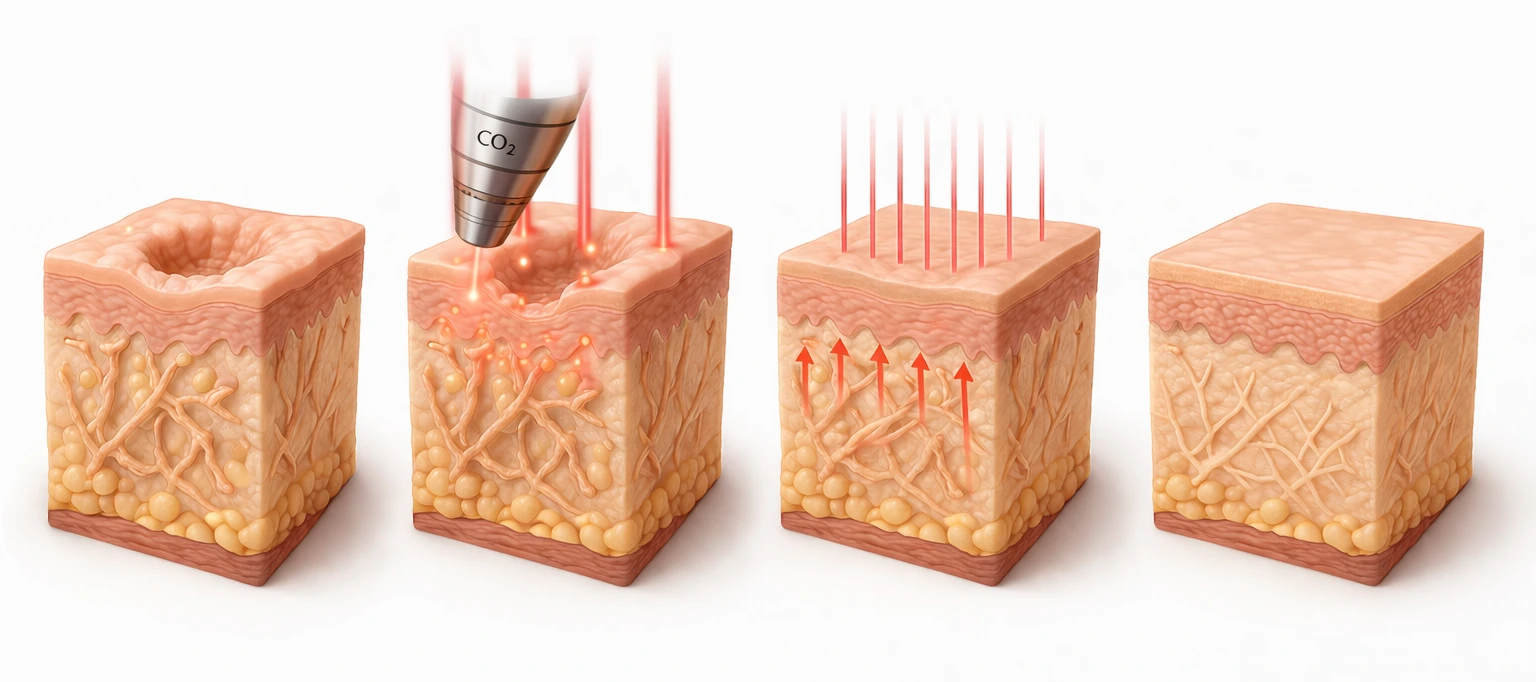
Shaving the bump down looks like the obvious answer, but it suits this scar poorly. What the scar actually is, is not a lump of flesh sitting on the surface but fibrous tissue that has hardened deeper in the skin. Tidy up only the surface and the hardened tissue underneath stays where it is, pushing back up over time — and if the depth removed goes even slightly too far, what is left this time is a depressed mark instead.
The pinhole technique comes at it from the other direction. Rather than removing the hardened tissue, it opens paths inside it. Through those fine channels the tissue gets room to breathe and rearrange, and the skin is guided into healing towards a flatter surface on its own. That is also why the change is gradual across a series of sessions rather than dramatic after one.
Opening precise micro-channels
A CO2 laser is used to make very fine, pinprick-sized channels through the scar. The spacing and depth of those channels depend on how firm the scar is and where it sits.
Letting the tissue rearrange
Through the openings, tissue that had hardened softens and is guided into flattening on its own. The change appears over the weeks the tissue takes to heal, not immediately after the session.
Protecting the surrounding skin
Only the centre of the scar is targeted and the surrounding normal skin is left alone, which minimises the risk of the surrounding area sinking in after the session.
What to expect and how long it takes
To be straightforward about it first: a papular scar is not the kind of scar that disappears in one session. Hardened tissue needs time to rearrange, and that process accumulates a little at a time across sessions. If you are expecting to see the result the moment you get up from the chair, you will be disappointed.
The usual course is a few days of fine crusting that then flakes away, and as that site heals the scar settles a little lower over several weeks. Leaving 8–10 weeks before the next session is a way of waiting for that healing to finish. Shortening the interval does not make the result come faster.
Where you set the goal matters too. What this treatment aims at is not erasing the mark entirely, but evening the surface out enough that light coming from the side no longer casts a shadow. Makeup sitting flat, and the scar not catching your eye when you are seen from the side, is a realistic place to aim. Individual results vary.
Treatment Interval
8–10 weeks apart
The tissue needs that long to regenerate properly.
Recommended Sessions
At least 3
With repeated sessions you can see the scar becoming progressively flatter.
After the Session
Fine crusting
It has to be left to come away on its own.
Aftercare
Very small crusts form over the scar right after the session. These crusts act as a cover while new tissue settles in, so they should not be forced off — leave them until they come away on their own. Picking them early can leave pigment behind, or leave the mark visible for much longer.
While the crusts are there you can wash your face as usual, but without rubbing, and you need to be especially careful with sunlight. Healing skin takes on pigment easily, and it is common for the scar itself to improve while that exact spot stays darker than the skin around it. Using sunscreen even indoors is the safer habit.
Makeup is safe from the point the crusts have fallen away on their own. Covering them before that can drag them off and leave a mark. On the day of the session, keep to a light cleanse; from the next day you can go back to your usual skincare as long as you avoid rubbing.
Exfoliating products, retinol and high-strength vitamin C and anything else irritating should wait until the crusts are fully gone and the redness has settled. Moisturising, by contrast, is worth doing generously — it helps the recovery.
Saunas, heated bathhouses and exercise that makes you sweat heavily should be avoided for a few days, since heat and irritation get in the way of healing. Alcohol adds to the swelling.
If during recovery you have pain that is unlike the usual soreness, any discharge, or redness that is spreading, please contact us rather than waiting for your next appointment.
What changes by area
The nose and the sides of the nose are where papular scars turn up most often. The sebaceous glands there are large and the skin is thick, so acne settles deep and there is more room for fibrous tissue to bunch up during healing. Because the skin is thick, though, recovery in this area can feel slower, so the course is planned with more sessions in mind.
The chin and jawline are where hormonally driven acne keeps recurring, so even after the scars are treated, new acne coming through will produce new ones. In this area the scar treatment and the acne management are handled together.
They also appear on the forehead and cheeks, though less often. If you have a raised lesion in one of those areas, it may be something other than a papular scar, and identifying it comes first.
How it differs from other acne scars
Acne scars divide broadly into the ones that sink and the ones that rise. What people usually mean by an acne scar is the sunken kind; a papular scar is the raised kind. The direction is opposite, so the treatment approaches it from the opposite side too.
Depressed scars come from tissue that is missing, so they are filled or induced to regenerate. Papular scars come from tissue that has bunched together, so they are loosened. It is common to have both kinds on one face, which can mean different methods for different areas.
When the skin is neither raised nor depressed and only the mark is left, red or brown, that is not a scar but a pigment or vascular issue. Those can fade with time, and the laser approach to them is different again.
Frequently asked questions
How many sessions will I need?
At least 3 sessions are recommended. It varies with how firm the scars are and how many there are, so the number is decided at an in-person examination.
Can I go about my day normally after the session?
Fine crusts form for a few days, but they do not get in the way of daily life. The crusts need to be left to come away on their own.
Is a keloid treated the same way?
No. The mechanism is different, so the approach is different. If a scar is red, itchy or getting bigger, it needs to be identified first.
I kept having steroid injections — why did nothing improve?
A papular scar has no active inflammation left for the injection to act on, so there is nothing for it to work against. Repeating it can thin the skin around the scar instead.
Will the scar go away completely?
Rather than complete removal, the goal is to even the surface out enough that light coming from the side no longer casts a shadow. Individual results vary.
Can I shorten the gap and finish sooner?
The tissue needs time to regenerate, which is why sessions are 8–10 weeks apart. Shortening the interval does not make the result come faster.
What if I have depressed scars as well?
Having both kinds on one face is common. Because they run in opposite directions, different areas are approached in different ways.
This page is general information about a treatment and is not a diagnosis or a recommendation. The right choice differs by skin condition, so treatment is decided after an in-person examination. Individual results vary.
Related information
Related conditions
- Acne marks — what stays behind as redness or pigment — Not a scar, but a pigment or vascular issue
Treatment pages
- The papular scar treatment page — The CO2 pinhole technique treatment page
- Marks and scars — treatment overview — Depressed scars and other kinds of scarring
- Clinic information and directions — Dosan-daero, Gangnam-gu, Seoul — appointments and enquiries