
Acne • Pores
Adult Acne: What It Is and How It Differs from Rosacea and Perioral Dermatitis
- Written by
- The Other Dermatology medical team
- Published
- 2026.08.21
Long past adolescence, many adults still find red, tender breakouts coming back along the jawline, around the mouth and on the cheeks. Adult acne is a condition with a chronic course in which hormonal factors, stress and a weakened skin barrier are tangled together. Literature on adult women describes that, because of the way it runs, maintenance treatment over several years is usually needed.
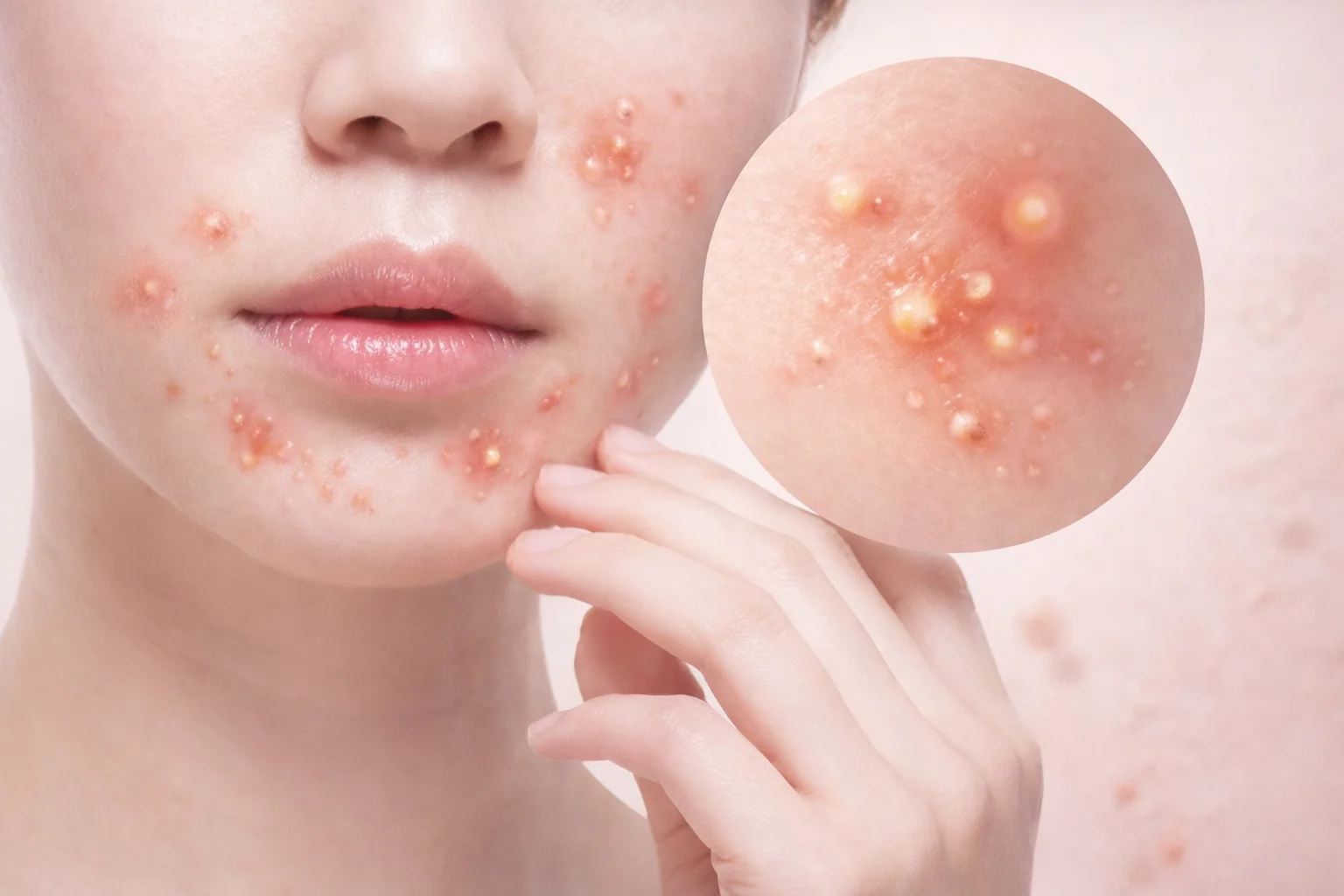
What is Adult Acne?
Acne can carry on past the age of 25, or appear for the first time in adulthood in someone who had none at school. Acne that continues into, or begins during, adult life is called adult acne (post-adolescent acne). Literature on adult women divides it into a persistent form carried over from puberty and a late-onset form that appears for the first time in adulthood; in the same paper the late-onset form was reported at 18.4%. The rest were cases carried over from adolescence.
In a questionnaire given to 1,013 adults aged 20 and over, 73.3% answered that they had had acne, and in every age group beyond the teens women reported it more often than men (in their twenties, 50.9% of women against 42.5% of men; in their thirties, 35.2% against 20.1%; in their forties, 26.3% against 12.0%). These are self-reported answers on a questionnaire rather than prevalence confirmed by examination, and the sample was gathered at a university campus and a medical complex in the United States. Teenage acne is described as more common in males, while post-adolescent acne is described as predominant in females. Prevalence data in a Korean population could not be confirmed.
Adult acne has commonly been said to stay within the chin and mandible — the so-called U-zone — and to involve few comedones. Yet in an international observational study in which 374 adult women aged 25 and over were examined directly in dermatology clinics, 89.8% had lesions spanning the cheeks, forehead, mandible and temples, with a severity spectrum similar to that of teenage acne, and only 11.2% were confined to the mandible. In the same study, 93.7% had comedones on the face. That this was a clinic sample of women who had come to a dermatologist for acne has to be taken into account, but it means that whether breakouts cluster on the chin is not enough on its own to identify adult acne.
Inflammatory acne is commonly attributed to stress, and premenstrual flares are also reported as common. In a study in which 22 university students were assessed repeatedly during examination and non-examination periods, an increase in acne severity was associated with an increase in stress (r=0.61). In the same study, change in diet quality showed an association as well. Beyond that, hormonal factors such as pregnancy, polycystic ovary disease, and medications or supplements with androgenic activity can matter, and oily face creams and smoking have been associated with comedonal acne.
In people with acne, impaired skin barrier function — assessed through measures such as increased transepidermal water loss (TEWL) — has been reported. Literature on adult women notes that skin at this stage can be more sensitive to irritation than in adolescence and less tolerant of topical medication. How long the red marks or pigmentation left once a lesion settles will last varies a great deal from person to person, so it is judged by looking at the skin during a consultation.
How is it different from Rosacea and Perioral Dermatitis?
When red papules and spots keep coming back on the chin, around the mouth or on the cheeks, it is easy to self-diagnose them as acne — but they need to be told apart from rosacea and perioral dermatitis. All three overlap in producing red papules and pustules on the lower part of the face.
Adult acne frequently shows comedones — blackheads and whiteheads formed when the follicular opening is blocked and sebum is trapped — present as an underlying lesion, mixed with inflammatory papules, pustules and nodules that developed out of them. In the study cited above, 93.7% had comedones on the face, and 6.4% had inflammatory lesions only.
Rosacea, by contrast, is described as having no comedones, and that is the point of separation from acne. It is dominated by recurrent flushing, erythema and telangiectasia over the central face — both cheeks including the nose, the chin and the forehead — with papules and pustules appearing alongside. It is divided into four clinical subtypes: erythematotelangiectatic, papulopustular, phymatous and ocular.
Perioral dermatitis likewise has no comedones. Small inflammatory papules and pustules, or pink scaly patches, appear around the mouth, usually sparing the vermilion border of the lips, and can spread toward the eyes or the nose. Steroid use by any route — topical, inhaled or nasal — is reported as the most commonly associated factor, and the course typically involves an initial response to the steroid followed by a flare when it is stopped. It is described as somewhat common in fair-skinned women aged 20 to 45, which overlaps with the people who worry about adult acne.
The three look alike but are approached differently, and telling them apart is settled in the consulting room by looking at the distribution and form of the lesions together with the cosmetics and ointments that have been used so far.
Rosacea and Perioral Dermatitis
- Comedones present?
- The absence of comedones is described as the discriminating feature of both rosacea and perioral dermatitis
- Dominant findings
- Rosacea: flushing, erythema and telangiectasia over the central face. Perioral dermatitis: tiny papules, pustules and scaling around the mouth
- Where it appears
- Rosacea over the central face including the nose; perioral dermatitis around the mouth, usually sparing the vermilion border
- Clues seen in the consulting room
- Perioral dermatitis often responds while a steroid is being used and then commonly flares when it is stopped
Adult Acne
- Comedones present?
- Comedones are often present alongside as the underlying lesion (93.7% in a study that examined 374 adult women)
- Dominant findings
- A mix of inflammatory papules, pustules and nodules that developed out of comedones
- Where it appears
- **In data on adult women**, across several areas of the face — cheeks, forehead, mandible and temples (89.8%); confined to the mandible in 11.2%
- Clues seen in the consulting room
- If an antibiotic given for presumed acne brings no response, or makes things worse, other diagnoses such as fungal folliculitis are considered as well
How is it treated?
Adult acne is approached by separating lesions that recur in the same place from the overall sebum state of the face, while taking into account a skin barrier that has become sensitive to irritation.
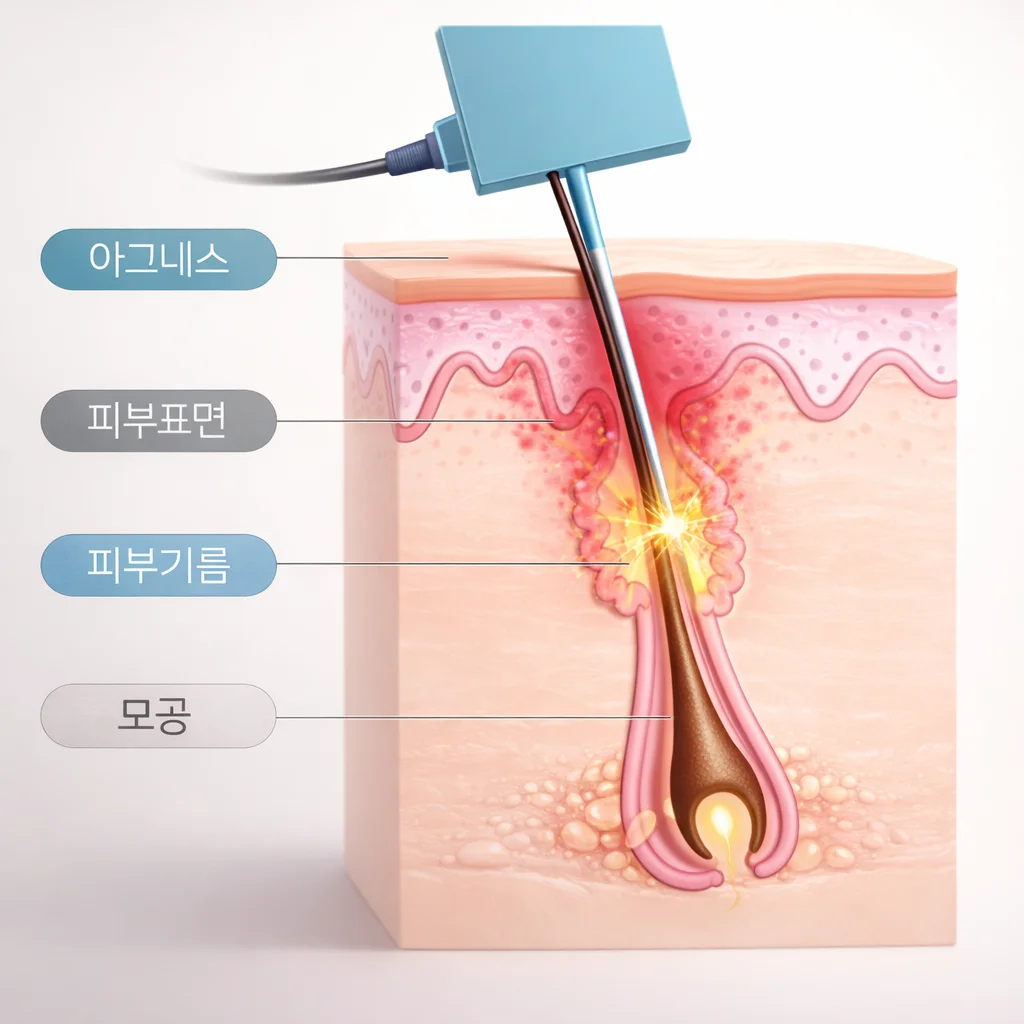
For suppurative lesions that recur chronically in a particular area, insulated microneedle radiofrequency (such as Agnes) is used. A specialized needle insulated to protect the epidermis delivers radiofrequency energy at the depth of the sebaceous gland, aiming at the glandular area that acts as the origin of repeated inflammation.
For lesions distributed widely across the face, photothermal therapy (PTT) may be used alongside. Specialized particles are delivered into the follicle and a laser of a particular wavelength is then applied to target the sebaceous glands. That said, the 2024 American Academy of Dermatology acne guideline stated that, for procedural categories such as chemical peels, laser and light-based devices and microneedling, the evidence is insufficient to develop a recommendation — so whether and how far they are applied is decided in the consulting room while watching the lesions and the response.
Since literature on adult women describes skin at this stage as sensitive to irritation and potentially less tolerant of topical medication, soothing anti-inflammatory care and moisturizing barrier care are kept within the same plan. The intensity of the procedures and the interval between them are adjusted against that response as well.
01 Sorting out the diagnosis and the distribution
We look at where the lesions are and what form they take, whether comedones are present, and assess the condition including the distinction from rosacea, perioral dermatitis and other conditions.
02 Targeting the sebaceous glands where lesions keep returning
For nodules that recur in the same place, such as along the jawline or around the mouth, insulated microneedle radiofrequency is used; for lesions spread across several areas of the face, PTT and similar approaches are placed instead. What is applied and how far it is taken is decided in the consulting room after looking at the distribution.
03 Settling the inflammation and fine extraction
Hygienic fine extraction and anti-inflammatory soothing care aim to limit secondary damage. Where inflammation sits deep, whether to extract at all is a judgment made in the consulting room.
04 Barrier care alongside
Moisturizing barrier care and recovery care are kept in the same plan, aiming to lower irritation after treatment.
What to expect and how long it takes
Treatment of adult acne is a gradual process that does not stop at settling the inflammation currently present; it aims to lower the activity of the sebaceous glands that drive the repeated recurrence.
It takes some time after a procedure for sebum and residual inflammation to clear, and depending on the hormonal environment and the state of the skin it may run over several sessions, with the number and the spacing decided in the consulting room. Literature on adult women describes that the clinical course of this condition usually calls for maintenance treatment over several years, and also notes that it can be resistant to treatment.
The aim of treatment is to lower how often and how strongly inflammation flares, but how much changes varies a great deal from person to person with the hormonal environment and the state of the skin, so the plan is designed in the consulting room.
After insulated microneedle radiofrequency and laser procedures, temporary redness (erythema), swelling and fine crusting can occur. How long these last depends on the depth of the lesions and the extent of the area treated, so it is explained individually during the consultation beforehand.
As sebum is discharged right after a procedure, a temporary acneiform eruption or folliculitis can come up. If that happens, the skin is assessed in the consulting room and the care and the interval between procedures are adjusted.
If sun protection is neglected after a procedure, or if the inflammatory reaction has been strong, post-inflammatory hyperpigmentation (PIH) can appear. Sunscreen should be applied carefully, and how much pigment remains is reviewed together during consultations.
Literature on adult women notes that skin at this stage can be more sensitive to irritation than in adolescence and less tolerant of topical medication. Adverse reactions such as infection of the treated area, burns and fine scar formation can be reported, so follow the aftercare you have been given, and if anything differs from what was expected, have it checked in a consultation.
Aftercare
While the skin is settling after a procedure, it is better to avoid activities that raise heat in the skin, such as saunas, steam rooms and vigorous exercise. How long that period lasts depends on the depth of the lesions and the extent treated, so follow the guidance given in the consultation.
Fine crusting or redness can appear temporarily where insulated microneedle radiofrequency or PTT was performed; take care not to pull the crusts off with your fingers.
Squeezing forcefully at home with your fingernails can lead to secondary infection or a pitted scar. For lesions where the inflammation sits deep, or that keep recurring in the same place, whether to extract at all is judged in the consulting room after looking at the skin.
Cleanse with a low-irritation cleanser, and use a non-comedogenic moisturizer rather than heavy, oily cosmetics. If you are also using a topical retinoid, its labelling states that exposure to sunlight and sunlamps should be minimized and that it should not be used where sunburn is present until recovery, so take particular care with sun protection. The same labelling states that abrasive soaps and cleansers, soaps and cosmetics with a strong drying effect, and products high in alcohol and astringents should be used with caution, and notes that weather extremes such as wind or cold can also be irritating. The same caution applies if you are taking an oral tetracycline-class antibiotic alongside — photosensitivity, manifested as an exaggerated sunburn reaction, has been observed in some people taking them.
What changes by area
Adult acne appears not only along the familiar jawline and mandible but across several areas of the face — the cheeks, forehead and temples. In the study that examined 374 adult women aged 25 and over directly, 89.8% had this distribution, and only 11.2% were confined to the mandible.
Inflammatory lesions are described as common along the jawline and around the neck, but the same sources also note that they can arise anywhere on the face, neck, chest and back. Large comedones are reported mainly on the chin, cheeks and forehead. Because the character of the lesions differs by area, the approach is set by looking at what has come up where.
For adult men, a prospective study of 1,384 adult acne patients across 21 countries reported sex differences in severity and lesion location. Data adequate to state the direction and magnitude of that difference could not be confirmed, however, so no conclusion is drawn here about the pattern by area in men.
Other conditions that look similar
Not everything that makes an adult face red and spotty is acne. Rosacea, centered on flushing and telangiectasia over the central face, and perioral dermatitis, in which tiny papules come up around the mouth, are separated by the absence of comedones, and they are approached differently.
If acne was assumed and antibiotic treatment was given but there was no response, or things got worse, fungal (Malassezia) folliculitis is considered as well. This form is described as spreading in a cape-like distribution over the shoulders, back and neck. This is not, however, a criterion you can sort out on your own — it is settled in the consulting room.
Where signs of androgen excess such as hirsutism, seborrhea, hair loss or menstrual irregularity are present together, or where premenstrual flares are marked, hormonal testing is recommended. A cross-sectional study (single center in Poland, n=354) also found that a group of adult women with acne had endocrine disorders more often than a group without (P=0.002).
Frequently asked questions
I had no acne at school. Can it really start for the first time as an adult?
Yes, it can. Adult acne is divided into a **persistent** form carried over from puberty and a **late-onset** form that appears for the first time in adulthood; in data on adult women the late-onset form was reported at 18.4%. The rest were cases carried over from adolescence. From the twenties onward it is described as emerging from stress, cosmetics and hormonal fluctuation tangled together.
Does adult acne only appear on the chin?
No. Inflammatory lesions along the jawline and around the mouth have long been described as common, but in a study that examined 374 adult women aged 25 and over, 89.8% had lesions spread across the cheeks, forehead, mandible and temples, and only 11.2% were confined to the mandible. Whether breakouts cluster on the chin is not enough on its own to identify adult acne.
Is adult acne free of whiteheads and small bumps?
Not so. In the same study 93.7% had comedones on the face. In adults, closed comedones and large comedones are described as making up a substantial share, and large comedones are reported mainly on the chin, cheeks and forehead.
Why should I not squeeze adult acne with my fingers?
Literature on adult women notes that skin at this stage can be more sensitive to irritation than in adolescence and less tolerant of topical medication. Forcing a lesion open can lead to secondary infection or a pitted scar, so whether a lesion is one that should be handled directly depends on its depth and the state of the inflammation, and that is assessed in the consulting room.
How is rosacea told apart from adult acne?
The feature described most often is the presence or absence of comedones (blackheads and whiteheads). Acne frequently has comedones underneath, whereas rosacea has none and is centered on flushing, erythema and telangiectasia over the central face. Perioral dermatitis, in which tiny papules cluster around the mouth, is likewise separated by the absence of comedones.
Does what I eat have anything to do with it?
In a systematic review, a high glycaemic index and increased glycaemic load intake showed a positive association with acne occurrence and severity, supported by randomized controlled trials, but the authors described the effect size as "modest". The same review concluded that the literature on dairy is mixed, and the meta-analyses that reported an association were observational studies in people aged 7 to 30 — so this is association, not causation, and publication bias and heterogeneity were noted. The 2024 American Academy of Dermatology guideline stated that the evidence is insufficient to develop a recommendation on dietary change.
Can skincare and cosmetics alone clear adult acne?
Non-comedogenic cosmetics and proper moisturizing do help with management. Adult acne is nonetheless a condition with a chronic course, and literature on adult women describes that maintenance treatment over several years is usually needed. How far it can be handled through daily care depends on the state of the lesions.
Is there anything I should know about oral sebum-suppressing medication (isotretinoin)?
It is contraindicated in pregnancy and can cause life-threatening birth defects. The labelling states explicitly that **if pregnancy occurs while taking any dose, even for a short period, the risk is extremely high**. Malformations of the face, eyes, ears, skull, central nervous system, cardiovascular system, and thymus and parathyroid glands are listed in the labelling. Whether it is prescribed, and the contraception and pregnancy testing required before and during treatment, are decided in the consulting room together with your general health and any plans for pregnancy.
If I am pregnant or planning a pregnancy, do I need to mention topical medication too?
Yes. **Topical retinoid (tretinoin)** is not written as an absolute contraindication, but the labelling states that, as there are no adequate controlled studies in pregnant women, it should be used during pregnancy only if the potential benefit justifies the potential risk to the fetus. The labelling also records that oral tretinoin was teratogenic in rats, mice, hamsters and non-human primates, and that over 20 years of clinical use 30 cases of temporally associated birth defects were reported, 5 of them in the holoprosencephaly category. **Oral tetracycline-class antibiotics (such as doxycycline)** are stated in their labelling to cause permanent discoloration of the teeth if used during the later part of pregnancy. If you are pregnant or planning a pregnancy, mention both topical and oral medication in the consultation first.
Can I stay on oral antibiotics indefinitely?
Labelling directs that oral antibiotics be used only in cases proven or strongly suspected to be caused by bacteria, in order to reduce the development of drug-resistant organisms. The 2024 American Academy of Dermatology acne guideline likewise offered, as a good practice statement, that systemic antibiotic use be limited and combined with topical therapy. Whether they are taken and for how long is decided in the consulting room after looking at the lesions.
Are there times when a procedure is postponed or the order changed?
Yes. If a viral infection such as herpes simplex, acute contact dermatitis or a bacterial infection is present where the procedure would be performed, that is treated first and the order is set in the consulting room. The same applies during a period when inflammatory cysts and nodules are widespread across the face. If you are prone to keloids or marked hypertrophic scars, mention that history before any invasive procedure so it can be reviewed together in the consultation.
This page is general information about a treatment and is not a diagnosis or a recommendation. The right choice differs by skin condition, so treatment is decided after an in-person examination. Individual results vary.
References
- Guidelines of care for the management of acne vulgaris J Am Acad Dermatol 2024;90(5):1006.e1-1006.e30 (Reynolds RV et al.)
- Adult female acne: a guide to clinical practice An Bras Dermatol 2019;94(1):62-75 (Bagatin E et al.)
- The prevalence of acne in adults 20 years and older J Am Acad Dermatol 2008;58(1):56-9 (Collier CN et al.)
- Adult female acne: a new paradigm J Eur Acad Dermatol Venereol 2013;27(9):1063-70 (Dréno B et al.)
- Large-scale international study enhances understanding of an emerging acne population: adult females J Eur Acad Dermatol Venereol 2015;29(6):1096-106 (Dréno B et al.)
- Diet and acne: A systematic review JAAD Int 2022;7:95-112 (Meixiong J et al.)
- Large prospective study on adult acne in Latin America and the Iberian Peninsula: risk factors, demographics, and clinical characteristics Int J Dermatol 2019;58(11):1277-82 (Kaminsky A et al.)
- The Skin as a Mirror of Internal Disease: Comorbidities and Epidemiology of Acne Vulgaris and Adult Female Acne - A Cross-sectional Study and Current State of Knowledge Acta Dermatovenerol Croat 2020;28(3):133-140 (Kaleta KP et al.)
- The response of skin disease to stress: changes in the severity of acne vulgaris as affected by examination stress Arch Dermatol 2003;139(7):897-900 (Chiu A, Chon SY, Kimball AB)
Related information
- Teenage acne and how it is treated — How acne in adolescence differs from adult acne
- The Other PTT for sebaceous glands — Targeting the sebaceous glands with photothermal therapy
- Acne marks left behind after inflammation — Care for the redness and pigmentation acne leaves behind
- Oil and sebum control program — Sebum care that takes shine and pores into account