
Acne • Pores
Enlarged Pores: What It Is and How It Differs from Excess Sebum
- Written by
- The Other Dermatology medical team
- Published
- 2026.08.21
Foundation keeps settling into them, and every time you look closely in the mirror the openings around the nostrils and across the front of the cheeks are the first thing you notice. Pores do not look enlarged simply because there is a lot of oil — the literature describes several factors acting together, including reduced support from the dermal connective tissue and the volume of the follicle itself (Lee 2016). This page sets out what the literature puts forward as the causes of pores looking enlarged, what has actually been measured to change with treatment, and what has not yet been established.
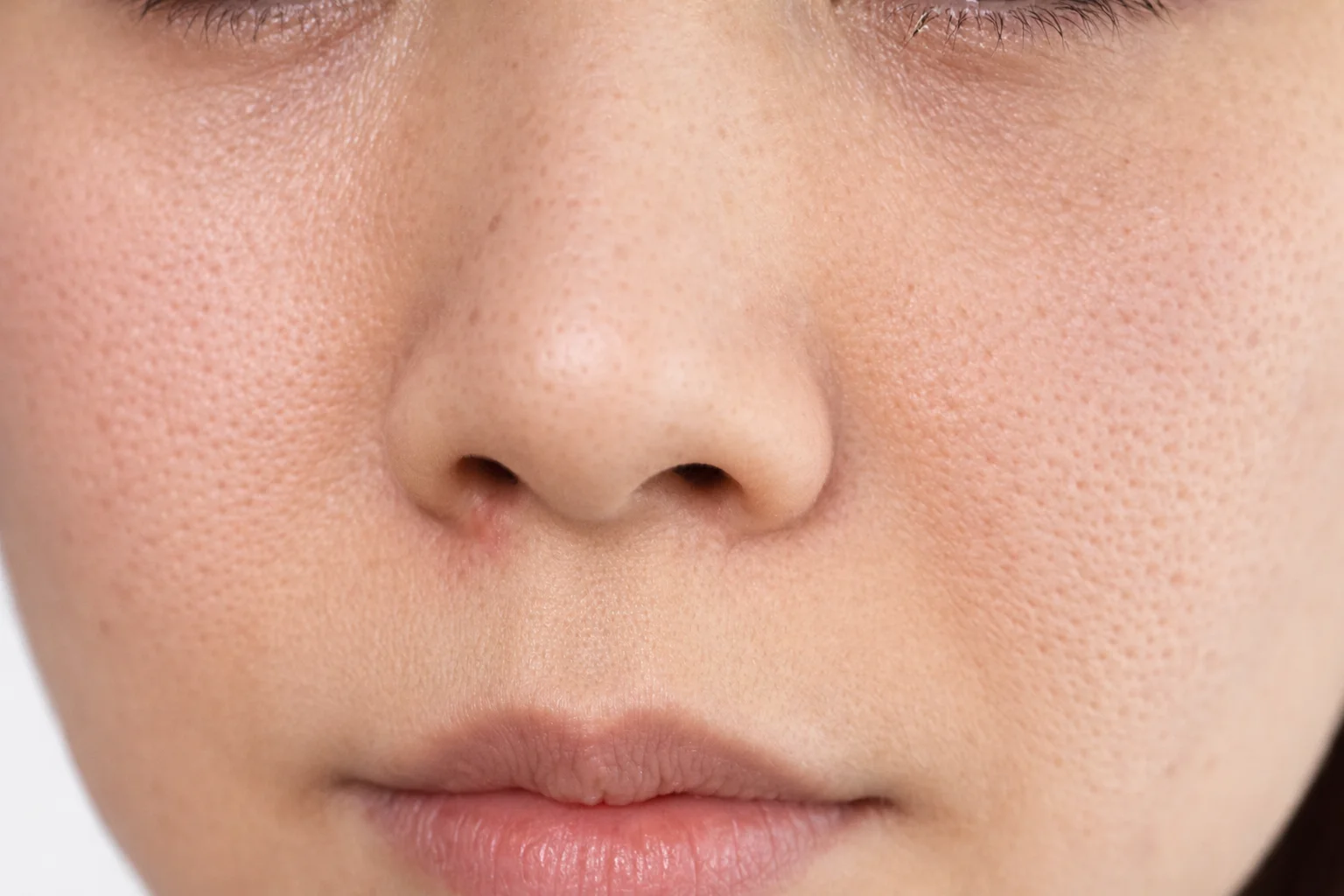
What is Enlarged Pores?
Look closely at the skin around your nose and across the front of your cheeks and you can make out small dots, or openings that read like the peel of an orange. Run a finger over the area and the texture is not smooth but slightly grainy, and after a while oil rises up through the openings and the skin turns shiny. In medical terms this is called enlarged pores (enlarged facial pores).
Anatomically, the pore you can see is not a single hole. The fine openings that are invisible to the naked eye belong to the sweat glands; what you actually see is the opening of a pilosebaceous follicle widened by packed keratin (Uhoda 2005). More precisely it is a shallow depression in the skin surface that holds several sebaceous and sweat gland openings, each individual opening sitting below the resolution of the naked eye (Flament 2015). So the description closer to the literature is not that one hole has grown larger, but that a depression has become conspicuous.
The clinical causes the medical literature gives for pores becoming enlarged are three — ① high sebum output ② loss of elasticity around the pore ③ increased follicle volume — with chronic recurrent acne, sex hormones and skincare habits layered on top (Lee 2016). The relationship between sebum and pores, however, does not run in a single direction within the literature. There are correlation reports that the greater the sebum output, the larger pores are observed to be (Roh 2006), while a study that measured 2,585 people stated explicitly that its findings do not support the view that pores arise primarily from a disorder of sebaceous gland function (Flament 2015). The elasticity side is somewhat more consistent — the lower the elasticity indices, the more pores were observed, and in the same study age and acne severity showed no clear relationship (Kim 2013).
The relationship with age also differs from what is commonly assumed. A study that automatically detected pores in Caucasian women reported that the size and density of pores are not affected by ageing, while their shape becomes elongated vertically (Shaiek 2017). A study that examined the tissue beneath conspicuous pores with confocal microscopy observed discontinuity of the dermal papillary structure alongside changes in the arrangement of the dermal fibres (Mizukoshi 2014).
A study that imaged the structure of enlarged pores directly (160 women) observed bright tubular structures around the follicle and a thickened hair shaft, together with a large attenuation of collagen from the surface toward the deeper layers. The authors put forward as a hypothesis that changes in the dermal matrix alter skin tension and in turn allow pores to widen (Nkengne 2021). In short, there is no single cause and it differs from person to person, so establishing which factor is mainly at work comes first, and that happens in an in-person consultation.
How is it different from Excess Sebum?
Many people with enlarged pores also have a lot of oil on the face, so it is easy to treat the two as one problem. Medically, enlarged pores and excess sebum are separate axes that are measured as different values.
Excess sebum is a state in which the secretory activity of the sebaceous glands is high, so the amount of oil produced per unit area is large; it is measured in ㎍/㎠ with a sebumeter. Enlarged pores is a state in which the pilosebaceous opening and the tissue around it have changed structurally, so the depression at the surface stands out; it is measured by image analysis as pore area, count, density and volume. Even within a single study the two are measured separately and reported separately.
The most direct evidence that the two are not the same comes from measurements by facial region. Follicle density and sebum output on the forehead, cheek, chin and nose each showed a gradient decreasing from the centre outward, but there was no correlation between the two values (Pagnoni 1994). That is, it is hard to say that the areas with more oil are the areas with more pores.
The targets of treatment diverge as well. On the excess sebum side the approach centres on lowering secretory activity itself, while on the enlarged pore side the dermal connective tissue around the opening is also a target (Lee 2016). Beyond that, no controlled trial has been identified that tested whether reducing sebum output reduces pores as measured by instrument. So a fall in oil on its own is not taken to mean that pores have been reduced.
Excess sebum (oil output)
- What the problem is
- Sebaceous gland secretory activity is high, so the amount of oil is large
- What is measured
- Sebum output per unit area (sebumeter, ㎍/㎠)
- What is seen alongside it
- Factors involved in secretory activity such as sex hormones; differences in output by facial region and season
- Target of treatment
- Lowering the secretory activity of the sebaceous glands itself
Enlarged Pores
- What the problem is
- Structural change in the pilosebaceous opening and the connective tissue around it
- What is measured
- Pore area, count, density and volume (image analysis)
- What is seen alongside it
- Structural change in the dermal connective tissue, lower elasticity indices, a thickened hair shaft
- Target of treatment
- The dermal connective tissue that supports the pore
How is it treated?
Enlarged pores are not settled by a single procedure, so the work proceeds by separating out the cause and then choosing a method to match it. The literature sets out three causes, and sorting them into types is a framework for explanation and treatment planning in the consulting room — it is not an academic diagnostic classification that assigns patients to categories.
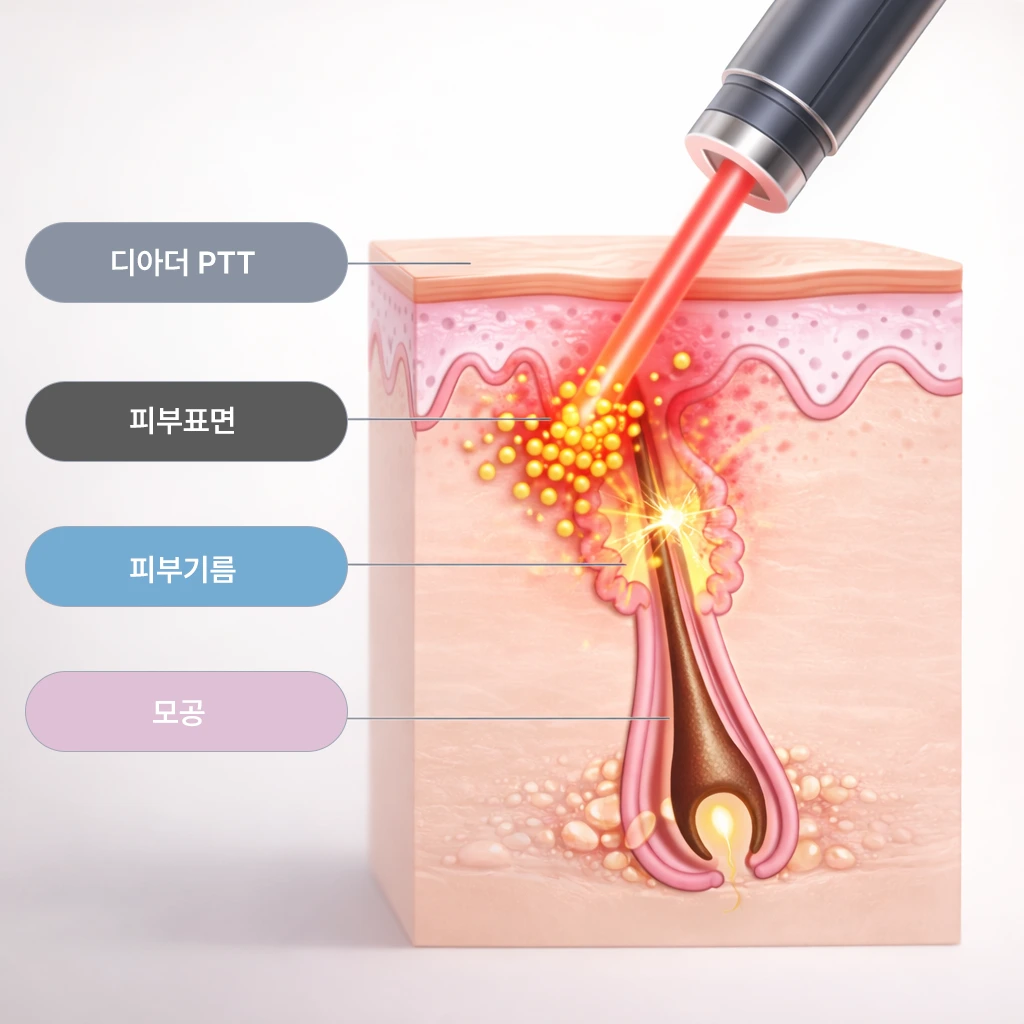
The first step is to use a skin analysis system and high-magnification photography to establish, as data, the things the naked eye cannot see: sebum levels, the presence of hair, and elasticity.
For the type with vigorous sebum output, photothermal therapy (PTT) is used. A study applying gold-nanoparticle photothermal therapy to 20 Korean patients reported reductions in pore size, count and index on the cheeks, but the authors of that same study wrote in their conclusion that whether sebaceous gland activity actually decreased has not yet been established (Choi 2022). Skin botox — botulinum toxin injected in fine amounts into the superficial dermis — is sometimes considered alongside it. That said, the use of botulinum toxin for sebum and pores is off-label in both Korea and the United States, and in placebo-controlled studies the reported effect generally lasts around 2 to 3 months (Roessle 2025).
For the type in which dermal elasticity has fallen and the pore stretches vertically, methods that deliver heat to the perifollicular dermis are used. Studies applying microneedle radiofrequency to pores reported improvement on physician assessment after several sessions (Huang 2024, Ren 2022), and with other heat-delivering modalities such as ultrasound or monopolar radiofrequency there are reports that pore volume was reduced (Vachiramon 2021, Techapichetvanich 2023). Most of these studies, however, have no untreated control group, and there is as yet no microneedle radiofrequency study that measured pore area by instrument. Which device is used under which settings is decided in an in-person consultation. If you are using an implanted cardiac device such as a pacemaker or a defibrillator, procedures that use radiofrequency cannot be performed — this is described as an absolute contraindication to radiofrequency treatment (Wollina 2011).
For the type in which fine hairs are lodged inside the pore and make it look dark and conspicuous, vellus hair removal is used to clear the hair. There are reports that a thickened hair shaft is observed alongside enlarged pores (Nkengne 2021), but no study has been identified that measured whether clearing the hair improves the pore.
Some things are checked before any procedure. Active acne or a local infection such as herpes simplex or warts at the treatment site, a chronic skin disease of moderate or greater severity (eczema, psoriasis), a blood disorder or ongoing anticoagulant therapy, a marked tendency to keloid formation, and ongoing chemotherapy or radiotherapy are all set out as contraindications to microneedling procedures (Singh & Yadav 2016).
During pregnancy and breastfeeding, there are no controlled studies establishing safety, so elective cosmetic procedures are usually deferred. No literature has been identified that supports a stronger statement than that (an absolute contraindication). If you are taking isotretinoin or have taken it recently, this should be disclosed at the consultation. Because the prescribing information and expert consensus reach different conclusions on how long a procedure should be deferred (Spring 2017, Waldman 2017), this page does not set a period.
A systematic review collecting 2,010 cases of complications from facial laser treatment records that ocular complications, while low in frequency, are among the most serious of the complications reported, and stresses that eye protection during treatment is essential (Zhorov 2026).
01 Detailed assessment
Skin analysis system and high-magnification photography — sebum levels, the presence of hair and elasticity are established as data, beyond what the naked eye can see.
02 Matching the type
A one-to-one treatment plan — based on the analysis, priority is set among sebum control, strengthening elasticity, and hair removal.
03 Targeted treatment
Precise treatment by a specialist — a method suited to each layer is chosen, with the aim of reducing how conspicuous the pores look.
04 Aftercare
Soothing and hydration — recovery care runs alongside treatment to reduce irritation afterwards and support healing.
What to expect and how long it takes
A pore is the channel through which sebum and sweat are discharged, and the pore you can see is a shallow depression in the skin surface holding several openings (Flament 2015). It is not a structure for which removal without a trace can be set as a goal, and the premise this field of research starts from is that in older skin pores do not appear to close again (Mizukoshi 2014).
Pain during and immediately after treatment can be more than mild. In a study treating pores with microneedle radiofrequency the mean reported pain was 6.4 out of 10 (Huang 2024); fractional lasers are reported lower than this. Immediately after treatment, erythema and swelling may appear along with petechiae (Qian 2023), and in some cases acneiform eruptions have been reported (Ren 2022).
The realistic goal of treatment is to make pores less noticeable. The values reported as improvement in clinical studies are mostly the number and density of pores detected by camera, and in one study the count fell by around 15% in the same patients while the diameter of the pores themselves did not change significantly (Puaratanaarunkon 2021, 59 patients, one session, 6 weeks). It is more accurate to understand this as the openings standing out less rather than becoming physically smaller.
It rarely ends in a single session. In a retrospective study of 75 patients who received microneedle radiofrequency, the rate of moderate or greater improvement after one session was 13.8% on the nose, 8.9% on the forehead and 11.1% on the cheeks, and the rate rose as sessions accumulated (Ren 2022). There is also a review noting that repeated sessions and combination treatment improved pore area and count further (Parvar 2023).
The point at which pore measures improve is reported differently by procedure and by person and is hard to bind into one figure, and the total number of sessions and the interval between them are planned in the consulting room. The longest follow-up identified among studies that tracked pores as an endpoint is 6 months (Vachiramon 2021, Techapichetvanich 2023), and no study following beyond 12 months has been identified. Beyond that point there is nothing this page can say.
Aftercare
In the early period after treatment the skin is recovering, so it helps to avoid strong irritation. How long care is needed differs with the procedure received, so follow the post-treatment instructions for the specific period and the activities to avoid.
Erythema, swelling and fine crusting after microneedle radiofrequency or laser treatment are reported as common reactions. Clinical studies describe them as temporary and reversible, but how long they last differs by procedure and by person, so follow the post-treatment instructions for the specific period. During that time, not touching or picking at the area helps recovery.
Applying and peeling off nose strips at home, or overusing a pore suction device, applies repeated physical traction to the pore opening and the skin around it, so they are worth avoiding. Plugs of sebum may come out for a time, but the pore is not physically reduced, and erythema can remain after extraction (Bencharattanaphakhi 2024).
In the systematic review collecting 2,010 cases of complications from facial laser treatment, the most frequently reported complication was post-inflammatory hyperpigmentation (PIH), particularly in darker skin (Zhorov 2026). In a study in Asian patients with enlarged pores, when two different lasers were applied to the left and right sides of the same face, pigmentation occurred in 52.6% versus 5.3% (1565 nm non-ablative fractional versus 1064 nm fractional picosecond, Qian 2023). Another study comparing the same two devices reported no difference (Liu 2024), so reports vary with the device and the settings. This is why sun protection is needed after treatment.
When going outdoors, apply sunscreen thoroughly to lower the risk of pigmentation after treatment, and apply moisturiser generously to keep the oil and water balance of the skin.
What changes by area
Pores look different depending on the region of the face. The forehead, nose and chin (the T-zone) measure as regions with higher sebum output than the cheeks (Youn 2005). That said, there is a report that within the same face there was no correlation between follicle density and sebum output (Pagnoni 1994), so it is hard to say that the regions with more oil are the regions with more pores.
No study has been identified that measured the distribution and shape of pores by facial region, and even the representative study measuring pores measured the cheek only, because of the size of the instrument (Flament 2015). There are retrospective reports that treatment response differed by region, but that is not material enough to decide which method is better for which region (Ren 2022). Which region is addressed by which method is judged in an in-person consultation that includes analyser measurements.
Other conditions that look similar
Not every fine opening visible on the nose or cheeks is a simple pore. Atrophic acne scars, where dermal tissue has been lost after acne inflammation, can look similar to pores but are structurally different, and studies measure scar volume and pore count separately, on different instruments (Puaratanaarunkon 2021). Even when both are addressed in the same procedure, the values being watched are different.
Where seborrhoeic dermatitis — sebum clumping around the nose with redness and scaling — or folliculitis is present, active inflammation or infection at the treatment site is listed as a contraindication to microneedling procedures (Singh & Yadav 2016), so the condition of the skin is checked first in the consulting room.
Frequently asked questions
Can pores be removed completely to give porcelain-smooth skin?
Pores are an essential physiological structure for discharging sebum and sweat, so removing them altogether is not possible. The goal of treatment is to make pores less noticeable, and the values reported as improvement in studies are mostly the count and density of pores. There is also a report in which, in the same patients, the count fell while the diameter stayed the same (Puaratanaarunkon 2021).
Do pores shrink if I use nose strips often?
They do not. What a nose strip pulls out is a sebaceous filament — sebum, bacteria and a single hair inside a sheath of keratinocytes — and this is not a lesion but a common morphological variant of the sebaceous follicle. After extraction the follicle refills within about 30 days (Plewig 1976). It is also worth knowing that repeated traction is applied and that erythema can remain after extraction.
Why do pores become elongated vertically?
There is a report that with age the size and density of pores do not change much while their shape becomes elongated vertically (Shaiek 2017). A study also observed changes in the dermal structure beneath conspicuous pores (Mizukoshi 2014), so this is taken to be related to the condition of the tissue supporting the pore.
What effect does skin botox have on pores?
Skin botox is a procedure in which botulinum toxin is injected in fine amounts into the dermis. Small studies have reported temporary reductions in sebum and improvement in pores, but placebo-controlled studies are few and the whole human literature amounts to 10 studies and 153 participants, which the systematic review in this field concludes is insufficient evidence to draw a conclusion (Rahman 2024). Use for pores and sebum is off-label in both Korea and the United States, and in a placebo-controlled study the effect was confirmed to around 8 weeks, with statistical significance lost by 12 weeks (Roessle 2025).
How long does pore treatment last?
The longest follow-up identified among studies that tracked pores as an endpoint is 6 months, and no study following beyond 12 months has been identified. What happens after that is outside what this page can speak to, so it is better to keep up sun protection and moisturising and to have the condition reviewed again.
How are pores different from atrophic acne scars?
A pore is a normal pilosebaceous opening, with the tissue around it standing out; an atrophic scar is a depressed lesion where the dermal tissue itself has been lost to inflammation. Studies also measure scar volume and pore count separately, on different instruments (Puaratanaarunkon 2021). Distinguishing the two should happen first in the consulting room.
This page is general information about a treatment and is not a diagnosis or a recommendation. The right choice differs by skin condition, so treatment is decided after an in-person examination. Individual results vary.
References
- The conundrum of skin pores in dermocosmetology Dermatology 2005 (Uhoda E et al.)
- Facial skin pores: a multiethnic study Clin Cosmet Investig Dermatol 2015 (Flament F et al.)
- Facial Pores: Definition, Causes, and Treatment Options Dermatol Surg 2016 (Lee SJ et al.)
- Sebum output as a factor contributing to the size of facial pores Br J Dermatol 2006 (Roh M et al.)
- Sebum, acne, skin elasticity, and gender difference - which is the major influencing factor for facial pores? Skin Res Technol 2013 (Kim BY et al.)
- Analysis of the skin surface and inner structure around pores on the face Skin Res Technol 2014 (Mizukoshi K, Takahashi K)
- A new tool to quantify the geometrical characteristics of facial skin pores. Changes with age and a making-up procedure in Caucasian women Skin Res Technol 2017 (Shaiek A et al.)
- Visible characteristics and structural modifications relating to enlarged facial pores Skin Res Technol 2021 (Nkengne A et al.)
- Determination of density of follicles on various regions of the face by cyanoacrylate biopsy: correlation with sebum output Br J Dermatol 1994 (Pagnoni A et al.)
- Regional and seasonal variations in facial sebum secretions: a proposal for the definition of combination skin type Skin Res Technol 2005 (Youn SW et al.)
- The efficacy and adverse effects of treatment options for facial pores: A review article J Cosmet Dermatol 2023 (Parvar SY et al.)
- Efficacy of a one-session fractional picosecond 1064-nm laser for the treatment of atrophic acne scar and enlarged facial pores J Cosmet Laser Ther 2021 (Puaratanaarunkon T, Asawanonda P)
- Efficacy and safety of fractional micro-needling radiofrequency for the treatment of enlarged pores on the cheeks of a chinese cohort: a retrospective study Lasers Med Sci 2024 (Huang Y et al.)
- Fractional microneedle radiofrequency treatment for enlarged facial pores: A real-world retrospective observational study on 75 patients J Cosmet Dermatol 2022 (Ren K et al.)
- A study of combined microfocused ultrasound and hyaluronic acid dermal filler in the treatment of enlarged facial pores in Asians J Cosmet Dermatol 2021 (Vachiramon V et al.)
- Nonablative monopolar radiofrequency for the reduction of facial pores and sebum excretion in Thai patients: A novel approach Lasers Surg Med 2023 (Techapichetvanich T et al.)
- Photothermal therapy using gold nanoparticles and a long-pulsed 755-nm alexandrite laser to treat facial photoaging in Asian skin: A prospective clinical trial Lasers Surg Med 2022 (Choi YJ, Kim JS, Kim WS)
- Intradermal Botulinum Toxin A on Skin Quality and Facial Rejuvenation: A Systematic Review and Meta-analysis Plast Reconstr Surg Glob Open 2024 (Rahman E et al.)
- Efficacy of Incobotulinumtoxin A on Maskne: Evaluation in a Prospective, Single-Center, Placebo-Controlled, Double-Blind Study J Cosmet Dermatol 2025 (Roessle A et al.)
- The comparison of the efficacy and safety of fractional 1064 nm Nd:YAG picosecond laser and nonablative fractional 1565 nm laser in the treatment of enlarged pores: A prospective split-face study Lasers Surg Med 2023 (Qian C et al.)
- Comparison of the 1064-nm picosecond laser with fractionated microlens array and 1565-nm non-ablative fractional laser for the treatment of enlarged pores: a randomized, split-face, controlled trial Lasers Med Sci 2024 (Liu X et al.)
- [Sebaceous filaments] Arch Dermatol Res 1976 (Plewig G, Wolff HH)
- A 595 nm pulsed dye laser as an adjuvant intervention for post-comedone extraction erythema and comedone reduction: A randomized, split-face controlled trial J Cosmet Dermatol 2024 (Bencharattanaphakhi R et al.)
- Facial laser complications (A Five Year Review) Lasers Med Sci 2026 (Zhorov I et al.)
- Treatment of facial skin laxity by a new monopolar radiofrequency device J Cutan Aesthet Surg 2011 (Wollina U) — describes cardiac pacemakers and defibrillators as absolute contraindications to radiofrequency
- Microneedling: Advances and widening horizons Indian Dermatol Online J 2016 (Singh A, Yadav S) — list of contraindications for microneedling
- Isotretinoin and Timing of Procedural Interventions: A Systematic Review With Consensus Recommendations JAMA Dermatol 2017 (Spring LK et al.)
- ASDS Guidelines Task Force: Consensus Recommendations Regarding the Safety of Lasers, Dermabrasion, Chemical Peels, Energy Devices, and Skin Surgery During and After Isotretinoin Use Dermatol Surg 2017 (Waldman A et al.)
- ACCUTANE (isotretinoin) capsule DailyMed SPL (setid 5b524a51-a16b-496e-b764-11c98c479c36) — US FDA prescribing information
Related information
- Excess sebum and oil control solutions — The adjacent topic that addresses output itself
- Telling atrophic acne scars apart from pores — How pores and fine scars differ, and how they are treated
- The Other PTT photothermal therapy — Photothermal therapy considered alongside, depending on the pore type