
Acne & Scar
Teenage Acne: What It Is and How It Differs from Folliculitis (including Malassezia folliculitis)
- Written by
- The Other Dermatology medical team
- Published
- 2026.08.21
Somewhere in puberty, small rough bumps start to be felt across the forehead and around the nose, and after a while red, swollen lesions begin to appear alongside them. Acne is common in adolescents and preadolescents aged 9 and over, and paediatric and adolescent acne is handled as a field separate from adult acne, so treatment differs according to age and pubertal status. This page explains what teenage acne is, what it is confused with, where standard treatment sits, and what this page is not yet able to answer.
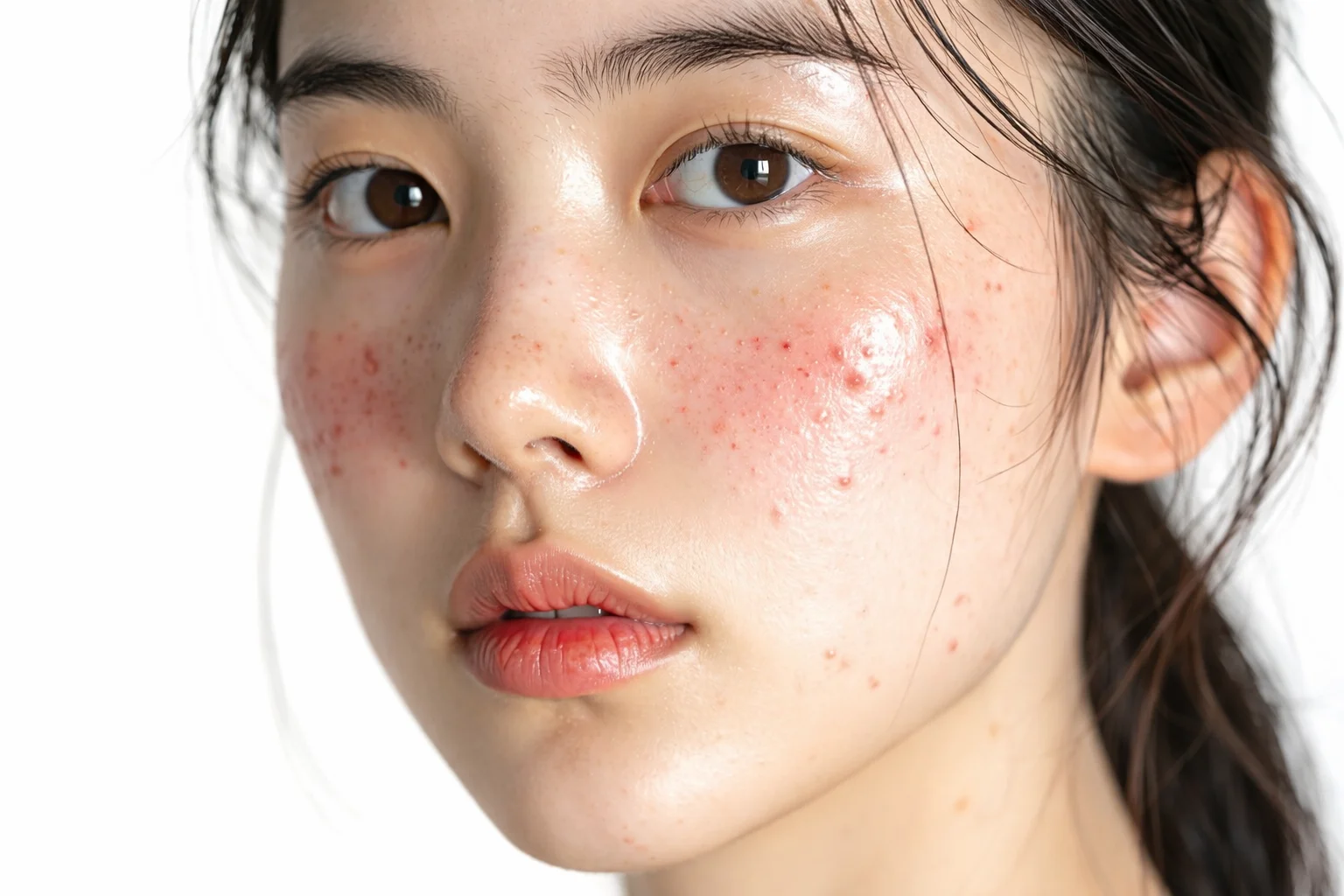
What is Teenage Acne?
In front of the mirror there are small, grainy bumps that can be felt across the forehead and around the nose, and before long red swollen spots or pustules start to appear among them. These changes, arriving with puberty, are called teenage acne, also termed adolescent acne.
Acne is common in adolescents and preadolescents aged 9 and over, and prevalence estimates in adolescents range widely between studies, from 35% to figures above 90%. Onset can begin as early as 7 to 12 years of age (preadolescent acne). This is an area where the data have not converged enough to be narrowed to a single figure, and prevalence data on Korean adolescents specifically were not located for this page.
Why it happens is a little different from what is commonly assumed. With puberty, DHEAS, the precursor of adrenal androgens, rises, and androgens stimulate the growth and secretory function of the sebaceous glands, leading to seborrhoea and acne. What the textbooks state, however, is that acne arises not because hormone levels are high, but because the sebaceous glands respond excessively to circulating androgens at normal levels. Acne severity has also been reported to correlate with pubertal maturation.
Younger adolescents are reported to begin with comedones on the forehead, nose and chin (the T-zone), and as it progresses, inflammatory lesions appear in addition to the comedones.
Picking or manipulating lesions is one of the four risk factors identified by a tool developed to assess the risk of atrophic acne scarring (the other three are the severity of acne at its worst, the duration of acne, and a family history of atrophic acne scarring). That tool was developed in young adults and its specificity was low at 43%, so having a risk factor does not mean scarring will follow.
Acne does not end with the lesions themselves. Suicidal ideation has been reported as more common in severe acne than in mild acne. This is an association and not causation, and it does not mean that acne produces depression. Still, the factors affecting quality of life in adolescents have been reported to differ from those in adults, so judgement is not made from the lesions alone.
How is it different from Folliculitis (including Malassezia folliculitis)?
Not every red eruption that appears on the face or body during adolescence is acne. One of the conditions that most closely resembles it is Malassezia folliculitis.
In acne, open and closed comedones — plugs of sebum and keratin inside the follicle — are seen alongside the other lesions. The pattern of progression starts from comedones, with red papules and pustules added on top.
Malassezia folliculitis, by contrast, arises when Malassezia, a genus of yeast, proliferates inside the hair follicle. It presents as erythematous papules and pustules that can look much like acne, and it may or may not be accompanied by itching. Lesions are around 2 to 4 mm in size, and the reported sites of predilection are the back, chest and neck. Worldwide prevalence has been reported in the range of 1% to 17%.
The presence of open and closed comedones together with an absence of itching points toward acne rather than Malassezia folliculitis. This is a leaning rather than a criterion for deciding, and a definite diagnosis is made in the clinic with a KOH smear and culture. The distinction should not be made on appearance alone at home; it needs to be confirmed at an in-person visit.
Folliculitis (including Malassezia folliculitis)
- Comedones (open and closed)
- Absence of comedones is what is suggested
- Itching
- May or may not be present
- Lesion size
- Reported at 2 to 4 mm
- Sites of predilection
- Back, chest and neck
- Confirming the diagnosis
- KOH smear and culture
Teenage Acne
- Comedones (open and closed)
- Open and closed comedones are present
- Itching
- Absence of itching is what is suggested
- Lesion size
- —
- Sites of predilection
- Forehead, nose and chin (the T-zone)
- Confirming the diagnosis
- —
How is it treated?
The standard of care for acne is benzoyl peroxide, topical retinoids, topical antibiotics and oral doxycycline, all strongly recommended by international guidelines. For acne that is severe, that carries a psychosocial burden or causes scarring, or that has failed standard oral and topical treatment, oral isotretinoin is strongly recommended.
The same guidelines list, as good practice, combining topical treatments with different mechanisms of action and limiting the use of systemic antibiotics. And because paediatric and adolescent acne is handled as a field separate from adult acne, treatment differs according to age and pubertal status. When The Other considers procedures alongside this, it is not to replace that standard, but to have them available to choose from according to what is found at the visit.
Some of these medicines carry clear age limits. Tetracycline-class antibiotics such as doxycycline, if used during tooth development (the latter half of pregnancy, infancy, and childhood up to the age of 8), can cause permanent discolouration of the teeth (yellow-grey-brown) and enamel hypoplasia, so the labelling restricts their use in children aged 8 and under to severe or life-threatening situations where the benefit outweighs the risk, particularly when no alternative therapy is available. Most middle and high school students are past that age, but the fact that there are ages at which these drugs cannot be used is checked before any prescription.
Isotretinoin is used for severe recalcitrant nodular acne in non-pregnant patients aged 12 and over. If pregnancy occurs while taking it — at any dose, even for a short period — there is an extremely high risk of life-threatening birth defects, and there is no accurate means of determining before birth whether a fetus has been affected. Patients who can become pregnant use two forms of contraception simultaneously (at least one a primary method), from at least 1 month before treatment begins, throughout treatment, and until 1 month after stopping, with a pregnancy test for each prescription. Hypersensitivity to isotretinoin or to vitamin A is also listed as a contraindication.
On matters relating to growth, spontaneous reports in the literature of premature epiphyseal closure at recommended doses have appeared, and in an open-label extension trial with 10 participants that included ages 13 to 17, 2 had a decrease in lumbar spine bone mineral density of up to 3.3%. Spontaneous reports are not an established causal incidence rate, and the bone density figures come from 10 people without a control group — but because this is the item closest to readers who are still growing, the denominator is given here as it stands.
On mood, the evidence runs in two directions at once. The labelling maintains warnings about depression, psychosis and, rarely, suicidal ideation, suicide attempts and aggressive behaviour, while a meta-analysis pooling 25 studies and 1,625,891 people found no increase in the risk of suicide or psychiatric disorders at the population level (all psychiatric disorders RR 1.08, 95% CI 0.99–1.19). Causation has not been established, and monitoring for mood changes during treatment is recommended. This is not something to begin knowing only one side of.
For lesions that repeatedly fill with pus, insulated microneedle radiofrequency (Agnes) is considered. It uses a single fine needle insulated along its upper shaft to deliver energy selectively to the sebaceous gland. In a randomised controlled trial of this method, the number of inflammatory lesions at week 12, after three treatments at 4-week intervals, was significantly lower than in the control group (P=0.03). However, the control group was not an untreated group but one that received microneedling and extraction, and the ages of the participants and the list of adverse events could not be confirmed from the abstract. The authors themselves note that theirs was the first randomised controlled trial of this method, which is how thinly the evidence is stacked in this area.
For lesions spread over a wide area, The Other PTT is considered. It uses light energy to suppress the activity of sebaceous glands distributed broadly across the skin. For the approach of delivering particles into the sebaceous glands and then applying an 800 nm laser, 2 randomised controlled trials in patients with moderate to severe facial acne — mean age 21, with a lower enrolment limit of 16 — reported improvement in inflammatory lesions after three treatments. In one of those trials (enrolling ages 16 to 26), inflammatory lesions were significantly reduced against sham treatment at 12 weeks (P=0.015) and 16 weeks (P=0.04). However, a Cochrane systematic review (2016) pooling 71 randomised controlled trials and 4,211 participants on light treatments for acne concluded that none, including studies comparing a gold microparticle suspension against vehicle, showed a clinically meaningful effect, and noted the lack of high-quality evidence for light therapy.
Because the two bodies of evidence point in different directions, this page does not make a definite claim about the effect. In addition, no study designed exclusively in minors was identified on either side, and whether the devices used in the literature above match the conditions of the devices used at this clinic was not verified for this page. Which method is applied, or whether one is applied at all, is decided at an in-person visit after looking at the distribution and severity of the lesions.
01 Consultation
A one-to-one consultation with a dermatologist, going through daily routines and the background to the acne together.
02 Planning
Minimising the risk of medication side effects, and deciding whether PTT or Agnes is the one to apply.
03 Procedure
The chosen method is carried out, targeting the sebaceous glands.
04 Guidance
Guidance on choosing skincare products and on washing habits, explained directly at a level the young patient can follow.
05 Aftercare
Follow-up care to settle the irritation left after the procedure.
What to expect and how long it takes
The aim in managing teenage acne is to reduce the chance that lesions worsen during puberty and are left behind as marks. A 1994 study of 185 patients referred to an acne clinic reported that the delay between the onset of acne and adequate treatment was related to the eventual degree of scarring, and that superficial inflammatory papules, not only nodules, were able to produce scarring. That group, however, consisted of patients referred to a clinic rather than the general adolescent population, so it is skewed toward the more severe end.
How much change appears at which point, and how many sessions are needed, could not be confirmed to the standard this page requires. That is why no time to onset, duration of effect, usual number of sessions or recovery period is given here. Androgen stimulation continues throughout puberty, so the condition can fluctuate during that time.
These procedures take around 30 minutes to an hour, including anaesthesia. Anaesthetics carry their own known risks. Systemic toxicity from local anaesthetics is rarer in children than in adults, but is reported at about 8 cases per 100,000 for injected anaesthesia, and several paediatric case reports following the use of topical anaesthetics also exist. Maximum doses of anaesthetic are set on the basis of body weight. Anaesthetic considerations in children and adolescents are not the same as in adults, so which anaesthetic is used and over what area is decided after an explanation at the visit before the procedure.
The risks the procedure itself carries should also be known from the outset. In the trial of particle-based photothermal treatment, erythema and perifollicular oedema lasted less than 30 minutes and no serious adverse events were reported, with pain scores averaging 3.5 to 3.9 out of 10. In the radiofrequency trial using an insulated microneedle, petechiae, pain and erythema were observed and were transient. These figures, however, come from participants with a mean age of 21 or whose age was not reported, and whether the same responses occur in growing skin was not confirmed.
A systematic review of adverse events from microneedling (51 papers, 1,029 patients) set out erythema, pain, swelling and transient irritation as expected responses, while also noting that train-track scarring was reported in 2 patients treated with radiofrequency microneedling for acne or varicella scars. Excessive pressure over bony prominences was presumed to be the cause. That report comes from treatment aimed at scars rather than active acne, but it comes from the same family of devices.
In a study of 44 patients aged 18 to 55 treated with non-insulated microneedle radiofrequency for acne scars, erythema was seen in every patient after the procedure, with oedema in 12 and post-inflammatory hyperpigmentation in 2. The condition treated, the type of needle and the age range all differ, so it cannot be carried across as it stands, but the fact that pigment change is among the reported responses should be known before starting.
The Cochrane systematic review of light treatments for acne rated the quality of the evidence on adverse effects as very low and stated that it is uncertain what the adverse effects are. That is why this page does not write the risks of these procedures down as small ones.
One more thing: the contraindication lists for PTT and for insulated microneedle radiofrequency were not obtained from the literature reviewed for this page. That is why no list of cases in which the procedure is not applied is given here. It does not mean there are no contraindications; it means they are not written without evidence. There are cases in which a procedure is postponed or not carried out, and those grounds are confirmed by looking at the skin at the visit before the procedure.
Aftercare
Recovery time after a procedure differs from person to person, so no single figure is given here. Which activities to avoid during recovery, and for how long, is explained at the visits before and after the procedure.
The treated area is left alone, not rubbed and not picked at. The same applies to squeezing lesions by hand — picking or manipulating lesions is counted as one of the four risk factors for atrophic acne scarring.
Washing is done gently, without scrubbing. How often to wash and which products to use depend on the state of the skin, so they are decided together at the visit. For what it is worth, there is no evidence that poor hygiene causes acne — it is not a condition that comes from not washing.
What changes by area
Younger adolescents are reported to begin with comedones on the forehead, nose and chin (the T-zone), with inflammatory lesions appearing in addition to the comedones as it progresses. That is as far as the literature reviewed supports, so this page makes no definite claim about which areas it spreads to next or in what order.
Material on whether scarring risk differs by area was not located in this round of research, so no ranking of risk by site is given. That said, superficial inflammatory papules as well as nodules have been reported to produce scarring, so a lesion is not judged simply by being small.
Other conditions that look similar
Not every rough bump that appears in adolescence is acne. Keratosis pilaris is red, rough, bumpy skin without pain or itching, appearing mainly on the extensor surfaces of the proximal arms and legs and on the buttocks. It is reported to affect 50% to 80% of adolescents, and it differs from acne in that it arises in childhood and improves with time. Treatment may give a cosmetic benefit, but textbooks note that there are no controlled clinical trials supporting this.
Verruca plana (flat warts) are flesh-coloured elevations 1 to 7 mm in size caused by HPV types 3, 10 and 28, and can number in the hundreds. Lesions that resemble one another in form can call for different directions of treatment, so this should be confirmed in the clinic before anything is started.
Frequently asked questions
Does it clear up on its own once puberty is over?
It is hard to assume that it will. **Acne has been reported to persist in about 64% of people in their twenties and about 43% in their thirties.** There is also a study in which the delay between the onset of acne and adequate treatment was related to the eventual degree of scarring. What to do now is decided at a visit, after looking at the condition.
Is it all right to squeeze acne at home with fingers or a needle?
It is not advised. **Picking or manipulating lesions is one of the four risk factors identified by a tool developed to assess the risk of atrophic acne scarring.** How lesions should be handled is decided at a visit, after looking at the condition.
Can a teenager have a sebaceous gland procedure?
**No study designed exclusively in minors was identified for these procedures.** Participants in the trials that were identified had a mean age of 21, or their ages were not reported. This page therefore does not answer in advance how effective or how safe these procedures are in adolescents. Whether they are applied, and under what conditions, is decided at an in-person visit after looking at the lesions.
Can teenage acne be managed with topical medication alone?
The standard of care for acne is topical medication (benzoyl peroxide, topical retinoids, topical antibiotics) together with oral medication where it is needed. Whether oral medication is required depends on severity, and oral antibiotics are recommended to be used alongside topical treatment and **ideally not beyond 3 months**. **Whether a procedure can take the place of medication is not something this page can answer in advance**; it is judged at a visit, after looking at the condition.
Is it because of not washing?
A systematic review states that **poor hygiene and natural light are not associated with acne**. No numbers for washing frequency or product conditions are given on this page because the literature reviewed contains no such criteria. Beyond washing gently without scrubbing, the rest is decided together at a visit, after looking at the skin.
Do certain foods need to be avoided?
No evidence pointing to a particular food was found. A 2005 systematic review found no clear evidence that dietary factors increase the risk of acne, noted **1 small randomised controlled trial suggesting that a low glycaemic index diet may reduce acne severity**, and stated that a possible association with dairy intake requires closer examination. This is an area where the evidence is still divided.
This page is general information about a treatment and is not a diagnosis or a recommendation. The right choice differs by skin condition, so treatment is decided after an in-person examination. Individual results vary.
References
- Guidelines of care for the management of acne vulgaris J Am Acad Dermatol. 2024;90(5):1006.e1-1006.e30 (Reynolds RV et al.)
- Evidence-based recommendations for the diagnosis and treatment of pediatric acne Pediatrics. 2013;131 Suppl 3:S163-86 (Eichenfield LF et al.)
- Epidemiology of acne vulgaris Br J Dermatol. 2013;168(3):474-85 (Bhate K, Williams HC)
- Acne Vulgaris StatPearls (NBK459173)
- Acne Treatment Based on Selective Photothermolysis of Sebaceous Follicles with Topically Delivered Light-Absorbing Gold Microparticles J Invest Dermatol. 2015;135(7):1727-1734 (Paithankar DY et al.)
- Light therapies for acne Cochrane Database Syst Rev. 2016;9(9):CD007917 (Barbaric J et al.)
- Selective Sebaceous Gland Electrothermolysis Using a Single Microneedle Radiofrequency Device for Acne Patients: A Prospective Randomized Controlled Study Lasers Surg Med. 2020;52(5):396-401 (Ahn GR et al.)
- Treatment of acne vulgaris with fractional radiofrequency microneedling J Dermatol. 2014;41(7):586-91 (Kim ST et al.)
- A Systematic Review Examining the Potential Adverse Effects of Microneedling J Clin Aesthet Dermatol. 2021;14(1):45-54 (Gowda A et al.)
- Efficacy and safety of microneedling radiofrequency in acne scars J Cutan Aesthet Surg. 2024;17(4):315-319 (Navyadevi U et al.)
- Local Anesthetic Toxicity StatPearls (NBK499964)
- Malassezia Furfur StatPearls (NBK553091)
- [Malassezia folliculitis] Ugeskr Laeger. 2020;182(47):V08200572 (Henning MA et al.)
- Keratosis Pilaris StatPearls (NBK546708)
- Wart StatPearls (NBK431047)
- DOXYCYCLINE CAPSULE — Labeling DailyMed (REMEDYREPACK INC.)
- AMNESTEEM (ISOTRETINOIN) CAPSULE — Labeling DailyMed (Mylan)
- Risk of Suicide and Psychiatric Disorders Among Isotretinoin Users: A Meta-Analysis JAMA Dermatol. 2024;160(1):54-62 (Tan NKW et al.)
- Systematic review of antibiotic resistance in acne: an increasing topical and oral threat Lancet Infect Dis. 2016;16(3):e23-33 (Walsh TR et al.)
- A clinical evaluation of acne scarring and its incidence Clin Exp Dermatol. 1994;19(4):303-8 (Layton AM et al.)
- Development of an atrophic acne scar risk assessment tool J Eur Acad Dermatol Venereol. 2017;31(9):1547-1554 (Tan J et al.)
- Predictors of Quality of Life in Adults and Adolescents with Acne: A Cross-Sectional Study Indian J Dermatol. 2022;67(3):239-246 (Yıldırım F et al.)
Related information
- How adult acne is treated — What distinguishes acne that persists past the age of 25
- The Other PTT for sebaceous glands — What photothermal treatment actually does
- Reconstruction for indented acne scarring — Treatment for the atrophic scars acne leaves behind
- Oil and sebum control program — Care when sebum production is heavy