
Acne & Scar
Acne Scarring: What It Is and How It Differs from Acne Marks
- Written by
- The Other Dermatology medical team
- Published
- 2026.11.09
What acne leaves behind may be sunken, raised, or only a flat change in color — and even under the one word "acne scar," each is handled differently. This page sets out in one place the types acne scars are divided into, how far the clues you see in the mirror go, and why the type itself is judged in the clinic.
What is Acne Scarring?
Acne spots look different from one person to the next in the mirror. A narrow, deep hole as if pricked by a needle; a small pit with angular edges; a broad, wavy dip that casts a shadow; a small skin-colored bump raised on the nose or chin; and a flat mark left red or brown — all of these tend to be called "acne scars" in a single word, but they are different things.
There are two broad branches. When the healing response falls short as acne inflammation heals and collagen is not fully replaced, the result is an indented scar (atrophic scar); when the response overshoots and fibrous tissue builds up, the result is a raised scar. Indented scars are widely divided into three. An ice pick scar is narrow and deep, a V shape whose opening is wider than its base. A boxcar scar is round or oval with walls that drop almost vertically, a U shape that can be shallow or deep. A rolling scar is a wider, gently undulating M shape: the dermis is held by fibrous bands to the subcutaneous tissue beneath and pulled down, so a shadow forms on the surface. The authors who proposed these three branches wrote that the type of scar has to be settled before a plan suited to it can be made.
Raised scars also come in different kinds. A hypertrophic scar is pink, firm and raised but stays within the borders of the original wound; a keloid is reddish-purple and grows beyond the borders of the original wound. After acne, these two scars appear mainly on the trunk, and keloids are more common in people with darker skin. Then there is the papular scar, proposed separately because it fits none of the categories above. It is a small skin-colored papule that tends to form on the nose and chin, and in tissue, fibrosis confined to the upper dermis is observed. More detail is in "Papular Scar: What It Is and How It Differs from Keloid."
How common each one is also differs. In an analysis pooling multiple studies, indented scars made up the majority of acne scars, and among them the ice pick type was reported most often. In a study at a university hospital dermatology department in Korea that classified, from photographs, 416 patients who came in for scars, indented scars were present in almost every patient, while keloid-type scars and papular scars were each found in slightly more than one in ten. Because one person could be counted in several categories, it is common for several types to be mixed on one face. In severe cases, the forms are described as overlapping so much that they are hard to tell apart.
So can the type of scar be told in the mirror? In an examination, the scar is looked at, felt, and the skin is stretched. Light from overhead rather than from the front brings scars out more, and stretching the skin reduces dips and shadows; whether a scar flattens when stretched is one of the clues a doctor uses to gauge it. Yet in a study where dermatologists sorted the same patients' scars into ice pick, boxcar and rolling, the shape judgments differed from one assessor to another and also when the same doctor looked again, and 65% of scars received the same judgment both times. The smaller the scar, the more the judgments diverged. How severe patients felt their own scars to be also matched the doctors' assessment only weakly. The mirror offers clues, but which type a scar is gets judged in the clinic.
How is it different from Acne Marks?
Acne leaves behind more than scars. Red marks (post-inflammatory erythema), where redness remains, and brown marks (post-inflammatory hyperpigmentation), where brown color remains, can appear before a scar forms or together with one, so it is common for marks and scars to be present on the same face. In people with lighter skin, red marks can also make scars look more prominent.
The axis that separates them is color or contour. A mark is a change in skin color; a scar is a change in the skin's level. Even the grading scale used to rate scar severity notes separately that flat color change, unlike its other grades, is a problem of color rather than contour. The course differs too. Marks tend to fade over time, though pigment sitting in the dermis can last a long time, while indented or raised scars generally persist.
So the direction of treatment differs as well. At The Other Dermatology, lasers aimed at blood vessels are used for red marks and lasers aimed at pigment for brown marks, while indented scars are handled with methods matched to their shape. Telling marks from scars is covered in more detail in "Acne Marks: What It Is and How It Differs from Indented Scars."
Acne Marks (Red Marks and Brown Marks)
- What changes
- Skin color — redness or brown
- Surface
- Flat
- Over time
- Tends to fade — pigment in the dermis can last a long time
- Direction of treatment
- Lasers aimed at blood vessels or pigment
Acne Scarring
- What changes
- The skin's level
- Surface
- Sunken or raised
- Over time
- Generally persists; disappearing completely is the exception
- Direction of treatment
- Methods matched to the scar's shape
How is it treated?
When a scar differs in direction and depth, the way it is handled differs too.
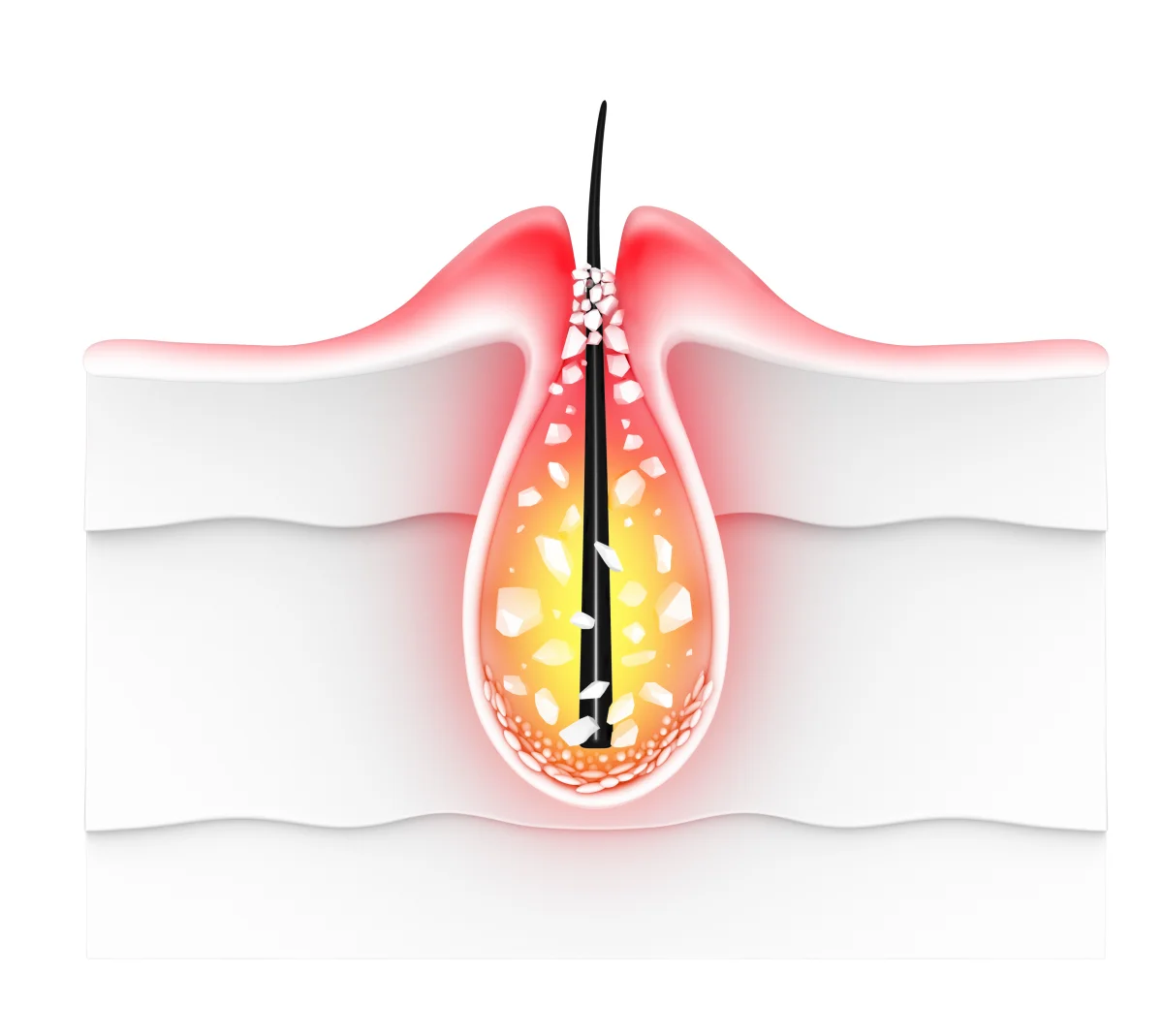
Methods for treating scars are described in three broad branches: removing layers of skin from the top down, lifting the floor of a deep scar toward the surface, and cutting the scar out. Which one fits is described as depending on the scar's shape and depth. A procedure that does not reach the depth of the scar is described as unlikely to succeed; shallow boxcar scars respond to methods that remove layers from above, while deep boxcar scars respond poorly. In a small study that measured scar depth in tissue, ice pick scars were the deepest on average. With rolling scars, the problem is less depth than the fibrous bands pulling from below, so a method that cuts those bands and frees the dip from the tissue underneath is used, and scars that flatten when the skin is stretched are described as suited to correction that adds volume.
The Other Dermatology handles indented scars by shape. For gently sunken rolling scars it uses subcision (subcutaneous incision), which cuts the fibrous bands; for angular boxcar scars, fractional laser together with shouldering, which softens the sharp edge of the wall; and for narrow, deep ice pick scars, dot peeling (TCA), which places a high-concentration agent on the base of the scar alone, point by point. Alongside these, pico fractional laser adds fine stimulation and CO2 fractional laser is used together when needed, and where the surface has sunk, a collagen booster and acellular dermal matrix (hADM) can be added. For raised papular scars it uses the CO2 pinhole technique, in which a CO2 laser makes very small openings in the scar and the hardened tissue is guided to remodel through those channels.
Among raised scars, hypertrophic scars and keloids run in the opposite direction. They are a problem on the side of collagen building up in excess, and the literature also groups their methods separately from those for indented scars. What The Other Dermatology uses for keloids is intralesional triamcinolone (TA) injection, 5-FU injection and lasers, and the criteria that separate keloids from hypertrophic scars are set out in "Keloid: What It Is and How It Differs from Hypertrophic Scar."
There is, however, no answer key by type. Several studies found that the same laser produced different responses depending on scar type, but the order of which type responded better was reversed from one study and device to another. A systematic review of acne scar treatments also concluded that there is no high-quality evidence to support any procedure as a first-line choice. When several forms are mixed on one face, two or more methods may be needed, so what to do in each spot, and in what order, is decided in the clinic after the scars are examined directly.
What to expect and how long it takes
Acne scars are generally a lasting change. They can improve somewhat with time or with procedures, but disappearing completely is described as the exception rather than the rule. This is where they differ from red and brown marks, which tend to fade over time. How much they improve depends on the scar's type and depth, and individual results vary.
When types are mixed, treatment is sometimes planned in stages. In a study that classified scars by shape and drew up a staged plan for each patient, most of the 168 who completed it went through one or two stages depending on their scar types, and some through three. The methods and intervals The Other Dermatology describes for each type are below.
Indented scars
Combined by shape
A method is chosen for each of rolling, boxcar and ice pick scars; the total number of sessions and the interval are decided in the clinic from depth, shape and skin response
Papular scars
Every 8–10 weeks · 3 or more sessions
An interval is left because the hardened tissue needs time to settle into place again
Keloids
Injections and laser
The interval and total number depend on the lesion's thickness, location and previous course, so they are decided at an in-person consultation
Aftercare
Care after a procedure depends on the scar type and the method received, and the details follow the guidance given at the clinic. After procedures for indented scars, the next session and the interval are set while watching reactions such as redness, crusting and bruising, and the cleaning and ointment instructions given, along with sun protection, are followed.
If acne is still active when indented scars or marks are being treated, stronger procedures are put off and treatment to calm the inflammation comes first.
What changes by area
Acne scars are most common on the face but also appear on the trunk. In a study that assessed 973 participants in dermatology research in Canada, scars were observed on the face in 87%, on the back in 51% and on the chest in 38%.
Where each type tends to appear also differs. Papular scars tend to form on the nose and chin, hypertrophic scars and keloids appear mainly on the trunk, and keloids are more common in people with darker skin.
Other conditions that look similar
Not every raised scar is the same. What separates a hypertrophic scar from a keloid is the border of the original wound — a scar that stays within it is a hypertrophic scar, and one that grows beyond it is a keloid. Papular scars on the nose and chin were proposed as a category different from either. In a Korean study, papular scars were more common in patients who had keloids, but what was reported is only a tendency to appear together; it does not mean that one causes the other.
Enlarged pores also tend to come up alongside indented scars. They are sometimes treated with the same procedures, but in studies they are measured as a separate indicator from indented scars.
Frequently asked questions
How many types of acne scars are there?
Broadly, two branches: indented scars and raised scars. Indented scars are widely divided into three — ice pick, boxcar and rolling — and raised scars include hypertrophic scars, which stay within the wound's border, and keloids, which grow beyond it. On top of these, papular scars, raised and skin-colored on the nose and chin, are added as a separately proposed category.
Which type is the most common?
In an analysis pooling multiple studies, most acne scars were indented scars, and among them the ice pick type was reported most often. In a study of scar patients at a Korean university hospital, too, indented scars were present in almost every patient. The proportions by type vary widely between studies, however, so they are hard to state as a single number.
Can I tell my scar type in the mirror?
In an examination, the scar's shape (narrow and deep, angular, or broad and wavy) is looked at together with the shadows that light from overhead creates and how the scar changes when the skin is stretched. Yet even dermatologists often disagreed with one another on the shape of the same scar, and how severe patients felt their scars to be matched the doctors' assessment only weakly. The shape seen in the mirror is only a clue, and the type is judged at the examination.
Can one person have several types?
It is common. Several reviews note that it is common for one patient to have two or more types of scar, and describe severe cases in which the forms overlap so much they are hard to separate. That is why different methods end up being used in different spots, even within one face.
Why does each scar call for a different method?
Because scars differ in direction (indented or raised), in depth, and in whether there are bands pulling from below. A method that does not reach the depth of the scar is unlikely to work, and for scars pulled down from below, such as rolling scars, methods that cut those bands are used. There is, however, no high-quality evidence establishing what works best for each type, so the specific combination is decided in the clinic.
Do scars go away on their own?
Acne scars are generally a lasting change; they can improve somewhat over time, but disappearing completely is described as the exception. What tends to fade with time is red and brown marks — though brown pigment sitting in the dermis can also last a long time.
This page is general information about a treatment and is not a diagnosis or a recommendation. The right choice differs by skin condition, so treatment is decided after an in-person examination. Individual results vary.
References
- Acne Scars: Pathogenesis, Classification and Treatment Dermatol Res Pract 2010 (Fabbrocini G et al.)
- Acne scarring: a classification system and review of treatment options J Am Acad Dermatol 2001 (Jacob CI, Dover JS, Kaminer MS)
- Prevalence and risk factors of acne scars in patients with acne vulgaris Skin Res Technol 2023 (Liu L et al.)
- A Neglected Acne Scar Type: Papular Acne Scars and Their Correlations With Keloid Scars Dermatol Surg 2021 (Lee YJ, Lee CY, Shin MK)
- Papular scars: an addition to the acne scar classification scheme J Clin Aesthet Dermatol 2015 (Gan SD, Graber EM)
- Hypertrophic Scarring Keloids StatPearls
- A Morphological Study of Acne Scarring and Its Relationship between Severity and Treatment of Active Acne J Cutan Aesthet Surg 2020 (Agrawal DA, Khunger N)
- Practical evaluation and management of atrophic acne scars: tips for the general dermatologist J Clin Aesthet Dermatol 2011 (Fife D)
- Postacne scarring: a qualitative global scarring grading system Dermatol Surg 2006 (Goodman GJ, Baron JA)
- New Atrophic Acne Scar Classification: Reliability of Assessments Based on Size, Shape, and Number J Drugs Dermatol 2016 (Kang S et al.)
- Development and validation of a Scale for Acne Scar Severity (SCAR-S) of the face and trunk J Cutan Med Surg 2010 (Tan JK et al.)
- A cross-sectional pilot study evaluating the histopathology of atrophic acne scars with a focus on the vertical depth of ice pick, boxcar, and rolling scars and its implications in skin of colour Indian J Dermatol Venereol Leprol 2026 (Bansal A et al.)
- Acne Scarring—Pathogenesis, Evaluation, and Treatment Options J Clin Aesthet Dermatol 2017 (Connolly D, Vu HL, Mariwalla K, Saedi N)
- Easy as PIE (Postinflammatory Erythema) J Clin Aesthet Dermatol 2013 (Bae-Harboe YS, Graber EM)
- Post-Inflammatory Hyperpigmentation StatPearls
- Acne scarring DermNet
- A Comprehensive Review of Non-Energy-Based Treatments for Atrophic Acne Scarring Clin Cosmet Investig Dermatol 2022 (Tam C et al.)
- Successful treatment of depressed, distensible acne scars using autologous fibroblasts: a multi-site, prospective, double blind, placebo-controlled clinical trial Dermatol Surg 2013 (Munavalli GS, Smith S, Maslowski JM, Weiss RA)
- Clinical Factors Affecting the Effectiveness of 1550-nm Erbium-Doped Fractional Photothermolysis Laser for Individual Atrophic Acne Scar Types Dermatol Ther (Heidelb) 2023 (Lee SR, Cho S)
- Resurfacing of different types of facial acne scar with short-pulsed, variable-pulsed, and dual-mode Er:YAG laser Dermatol Surg 2004 (Woo SH, Park JH, Kye YC)
- Interventions for acne scars Cochrane Database Syst Rev 2016 (Abdel Hay R et al.)
- Surgical treatment of facial acne scars based on morphologic classification: a Brazilian experience Dermatol Surg 2003 (Kadunc BV, Trindade de Almeida AR)
- Efficacy of a one-session fractional picosecond 1064-nm laser for the treatment of atrophic acne scar and enlarged facial pores J Cosmet Laser Ther 2021 (Puaratanaarunkon T, Asawanonda P)
Related information
Related conditions
- Keloid: What It Is and How It Differs from Hypertrophic Scar — The criteria that separate keloids from hypertrophic scars
- Acne Marks: What It Is and How It Differs from Indented Scars — Telling flat color marks from scars
Treatment pages
- Acne scars: laser and subcision — Treating indented scars by shape
- Papular scar treatment page — The CO2 pinhole technique for raised papular scars on the nose and chin